Television Review: The Loss (Star Trek: The Next Generation, S4X10, 1990)

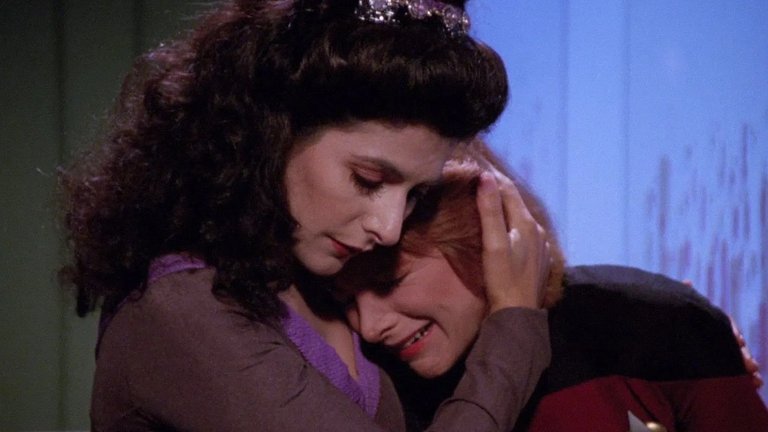
The Loss (S04E10)
Airdate: 31 December 1990
Written by: Hillary J. Bader, Alan J. Adler & Vanessa Greene
Directed by: Chip Chalmers
Running Time: 46 minutes
Following the creative zenith of its third season, Star Trek: The Next Generation’s fourth year often found itself settling into a comfortable, albeit underwhelming, routine. A procession of episodes emerged that were not objectively terrible but were rendered forgettable by their proximity to the series' greatest works. These installments frequently missed palpable opportunities for deeper exploration, favouring safe, formulaic storytelling over ambition. The Loss (Season 4, Episode 10) stands as a quintessential example of this trend: an episode with a compelling central character study fatally undermined by its attachment to a rote and technobabble-heavy ship-in-peril plot.
The nominal A-plot is a textbook piece of Trek peril. The USS Enterprise-D, en route to the planet T’Li Beta, encounters a strange cosmic phenomenon which instantly incapacitates the ship’s engines and begins dragging it inexorably towards a destructive cosmic string. The subsequent revelation, that this phenomenon is the work of massive collections of two-dimensional beings who simply cannot comprehend the three-dimensional damage they are causing, introduces a genuinely fascinating scientific and philosophical concept. However, all attempts at communication fail, and the crew’s frantic efforts to break free prove equally futile, leaving the ship on a collision course with annihilation. This premise, while solid in theory, quickly devolves into a series of technical jargon exchanges, lacking the suspense or intellectual rigour needed to elevate it beyond a routine ticking clock.
This external crisis dovetails—somewhat awkwardly—with a far more engaging personal one for Counsellor Deanna Troi. During a grief-counselling session, she is struck by a sudden, debilitating headache, which swiftly culminates in the total loss of her empathic abilities. Stripped of the sense that has defined her life and career, Troi responds with raw despair and anger. She lashes out at colleagues and she formally resigns her post, declaring herself incapable of serving as Counsellor without her innate gifts. The script wisely provides a counterpoint in Guinan, who volunteers to assume counselling duties, not out of ambition, but in a transparent and compassionate attempt to provoke Troi into reconsidering her rash decision. This segment forms the emotional core of the episode and is its greatest strength.
Ultimately, it is Troi, even in her “disabled” state, who deduces a solution. Analysing the two-dimensional beings’ behaviour, she posits they are drawn to cosmic strings “like moths to a flame.” This leads to idea to have the Enterprise mimic a cosmic string’s signature, which proves successful; the ship is released, and Troi’s empathic abilities return. The explanation—that the beings’ sheer, overwhelming joy at encountering the string created an emotional overload that “short-circuited” Troi’s Betazoid brain—is neat, if conveniently metaphorical.
The script for this character-driven plot originated from writing intern Hillary J. Bader, who would later become a prolific contributor to TNG, Deep Space Nine, and Voyager. Her core concept was to explore how an individual defined by a unique ability copes with its sudden absence. Bader drew inspiration from real-life experiences of disability, and the episode was later praised by some disability advocates for its authentic depiction of Troi’s grief, denial, and recalibration of self-worth. This narrative thread is solidly constructed, allowing Troi to be unusually vulnerable and, at times, unlikable, while affording actress Marina Sirtis a rare opportunity to demonstrate significant dramatic range beyond her typically serene demeanour.
Yet, the episode’s fatal flaw is the forced and ultimately detrimental intertwining of this promising character study with the lacklustre ship-in-peril plot. The scientific concept of cosmic strings is intriguing, but it is immediately compromised by unconvincing execution and a resolution that feels like a narrative contrivance. A glaring example of the script’s carelessness is the recurring character of Ensign Allenby. Portrayed by Mary Kohnert, this conn officer is written to be bafflingly ignorant of what a cosmic string is, despite her Starfleet training and bridge experience.
Furthermore, the episode misses several profound opportunities for deeper thematic resonance. Most egregiously, Troi’s intense personal crisis completely fails to intersect meaningfully with the experience of Lieutenant Geordi LaForge. Here is a senior officer who has navigated a lifetime with a significant visual disability, compensating and excelling through technology—the very embodiment of adapting to loss. That Troi never engages with him on this level, never seeks his perspective on defining oneself beyond one’s perceived limitations, represents a staggering failure of narrative logic and character insight. It is a missed opportunity so obvious it feels like a dramatic crime.
The weak, formulaic subplot involving Troi’s grief counselling of Ensign Janet Brooks—whose husband has recently died—further illustrates the episode’s tonal and structural unevenness. While actress Kim Braden strives to invest something genuine into her clichéd role, the scenes feel perfunctory, serving only to establish Troi’s professional setting before her crisis begins. They add little and are quickly forgotten.
Ultimately, The Loss is rendered inconsequential by the episodic conventions of its era. There was never any doubt that the Enterprise would escape its predicament or that Troi would regain her empathy. The reset button was always destined to be pressed. Consequently, any profound exploration of disability, identity, or adaptation is undercut by the foregone conclusion of a full restoration of the status quo. What remains is a curiously bifurcated instalment: one half a thoughtful, character-driven drama featuring one of Marina Sirtis’s best performances, the other a routine and forgettable sci-fi hazard. The two halves never cohere into a satisfying whole, leaving The Loss stranded, much like the Enterprise itself, in a narrative void—a capable idea pulled down by the gravitational drag of formula.
RATING: 4/10 (+)
Blog in Croatian https://draxblog.com
Blog in English https://draxreview.wordpress.com/
InLeo blog https://inleo.io/@drax.leo
LeoDex: https://leodex.io/?ref=drax
InLeo: https://inleo.io/signup?referral=drax.leo
Hiveonboard: https://hiveonboard.com?ref=drax
Rising Star game: https://www.risingstargame.com?referrer=drax
1Inch: https://1inch.exchange/#/r/0x83823d8CCB74F828148258BB4457642124b1328e
BTC donations: 1EWxiMiP6iiG9rger3NuUSd6HByaxQWafG
ETH donations: 0xB305F144323b99e6f8b1d66f5D7DE78B498C32A7
BCH donations: qpvxw0jax79lhmvlgcldkzpqanf03r9cjv8y6gtmk9