Television Review: The Shape of the Things to Come (Lost, S4X09, 2008)

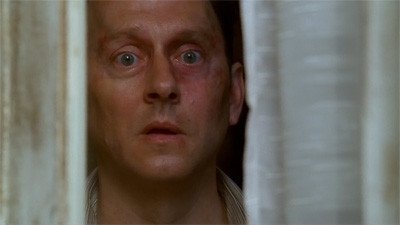
The Shape of the Things to Come (S0409)
Airdate: 24 April 2008
Written by: Drew Goddard & Brian K. Vaughan
Directed by: Jack Bender
Running Time: 42 minutes
Over the course of its six-season run, Lost demonstrated a remarkable capacity to venture into the dark depths of character psychology and existential dread. While the series frequently toyed with fate, destiny, and the metaphysical, few episodes illustrate this darker undercurrent as starkly as The Shape of Things to Come, the Season 4 finale. Originally aired following a prolonged hiatus, this episode served as a brutal punctuation mark on the season's narrative, suggesting that the deaths, pain, and misery experienced on the Island were not the result of blind chance or some grand, unseen hand, but the consequence of a tangible conflict that had taken a deeply personal and visceral turn. It was a watershed moment that confirmed the show’s trajectory was shifting from a survival puzzle to a complex saga of vengeance and consequence, an evolution that continued to resonate long after the characters finally left the Island behind.
The darkness of this instalment is inextricably linked to its relentless focus on Benjamin Linus, arguably the darkest of the show's regular characters. Ben becomes the primary target of a ruthless mercenary force, a group confirmed to have slaughtered Karl and shot Rousseau in cold blood, thereby capturing their daughter, Alex. The sonic barrier protecting Ben’s home at the Barracks is breached, and while Locke’s group receives a warning, it arrives too late to prevent chaos. Some of the survivors are mowed down by fire, and a house is obliterated by a LAW rocket. Yet, amidst the destruction, Ben displays the tactical brilliance and ruthlessness that define him. He manages to herd Sawyer, Hurley, Locke, Claire, and Aaron into a relatively secure and barrickaed house.
The mercenaries, having apparently captured Miles Straume, release him to Ben only to demand his unconditional surrender. The leader of this operation is Charles Widmore’s lieutenant, Keamy, a former US Marine and veteran of the Second Congo Civil War. He brings Alex forward, places a gun to her head, and demands Ben's surrender. Ben, trapped in a situation where surrender likely meant the execution of everyone he holds dear, attempts a bluff of pure psychological warfare. He claims that Alex is not his daughter and that he does not care for her. Keamy, unmoved by the theatrics, shoots Alex dead. The scene is a masterclass in television tragedy. Ben’s façade crumbles, leaving him overwhelmed by a pain so visceral it borders on the inhuman. His last words to his daughter, a desperate and futile attempt to save her life with a lie, hang in the air, making the moment one of the most emotionally devastating sequences in the series' history. As night falls, the Smoke Monster arrives to systematically dismantle the mercenary team, saving Ben—who, after a poignant goodbye to his dead daughter, leads Locke and Hurley to Jacob’s cabin.
The narrative tension is not limited to the immediate conflict at the Barracks. The episode cuts to the beach, a setting that usually provides a respite from the island's horrors. Here, the familiar flirtation between Jack and Kate is abruptly shattered by the discovery of a corpse washed ashore. His throat is slit, and Daniel Faraday identifies him as Dr. Ray, a doctor from the Kahana. Faraday attempts to communicate with the ship via Morse code, only to receive a cryptic confirmation from the ship that everything is "alright." Faraday explains that this anomaly suggests something is amiss with the ship's chronometry, hinting at the complex time dilation mechanics.
The episode features a series of flashforwards. We find Ben in a parka with a Dharma Initiative insignia, suddenly appearing in the middle of the Sahara Desert. After a bloody encounter with two nomad horsemen, he struggles to a Tunisian hotel and books a room on 24 October 2005. This date is significant; he watches a television news report featuring Sayid Jarrah, a celebrity member of the "Oceanic Six," being interviewed about a tragic violent event in Los Angeles. Five days later, posing as a journalist, Ben travels to Tikrit in US-occupied Iraq. He witnesses Sayid attending the funeral of his wife, Nadia, who had been murdered. Sayid is being watched by Ishmael Bakir (Faran Tahir), but Sayid ultimately kills Bakir, convinced he was responsible for Nadia's death. Ben tentatively reaches out to Sayid, attempting to persuade him to move on with his life. However, Sayid, consumed by grief and the belief that the same forces responsible for Nadia's death also killed Ben's daughter, joins Ben's cause of revenge. The episode concludes in a penthouse in London, where Ben confronts Charles Widmore. Unable to kill him directly, Ben vows to make him suffer by killing his daughter, Penny. Widmore, in turn, promises to find the Island again.
Like much of Season 4, The Shape of Things to Come was affected by the 2007–2008 Writers Guild of America strike. Originally intended to be a longer season, the strike forced the creators to compress the plot progression into only six episodes of season's second half. While this initially seemed like a gamble, the writers and producers later claimed it benefited the series, resulting in episodes that were more focused on forward momentum and event-driven storytelling rather than the exposition that might have slowed the pace down. This compression is evident in the density of the narrative; the episode is incredibly eventful, spanning four different continents and delivering a satisfying, if brutal, conclusion to the season’s immediate conflicts.
The writing, by Drew Goddard and Brian K. Vaughan, does not disappoint in this regard. The episode is a great example of pacing, balancing high-octane action with intimate character moments. It features a vast geographical scope, from the sun-baked sands of the Sahara to the streets of London, and boasts some of the most spectacular CGI effects in the series' history. The scene where the Smoke Monster takes out the mercenaries is particularly noteworthy; set at night to enhance the visual effects, it represents a pinnacle of the show's aesthetic ambition, blending practical effects with digital artistry to create a truly terrifying sequence.
However, the episode is even more impressive in its "wham" events, which throw characters—and viewers—into an emotional frenzy. The scene where Ben helplessly watches his daughter being murdered in cold blood stands as one of the most emotional moments of the entire series. Michael Emerson, who had previously played Ben with a mix of charm and menace, displays a raw, unadulterated pain and grief for the first time. He emerges as an excellent actor in this moment, carrying the weight of the tragedy with a gravitas that elevates the material. His performance transforms Ben from a villain into a tragic figure, a man whose actions have consequences that are painfully real.
The thematic resonance of the episode is further deepened by the phrase "he changed the rules." This cryptic remark, seemingly from the psychic Miles, suggests that the unpleasant fate befalling Alex might extend to other characters like Claire. This foreshadowing adds a layer of paranoia to the narrative, suggesting that the rules governing the Island are mutable and dangerous. Furthermore, the revelation that Sayid found love and married Nadia only to lose her instantly renders his character arc up to that point tragically futile. It is a dark, nihilistic twist that reinforces the idea that the Island is not a place of redemption, but a place where happiness is fleeting and vengeance is inevitable.
There are, of course, some flaws in the episode. The brief introduction of three "redshirt" Losties—who serve only to be unceremoniously killed by mercenaries in the opening salvo—feels like a narrative shortcut. Without any prior character development or references to them in previous episodes, their deaths feel like expendable plot devices rather than genuine emotional losses. It is a minor quibble in an otherwise dense episode, but it does highlight the compression of the season's narrative.
The irony of the title, borrowed from H.G. Wells' 1933 novel describing a technocratic utopia, is perhaps the most telling element of the episode. The world depicted in The Shape of Things to Come is one of corruption, violence, and deceit, driven by ancient grudges and personal vendettas. This world can, sadly, be recognised even today by audiences too young to understand the episode's specific references to the carnage in Iraq or the Second Congo Civil War. In this sense, the episode transcends its genre and becomes a commentary on the cyclical nature of violence and the human capacity for both cruelty and resilience.
RATING: 8/10 (+++)
==
Blog in Croatian https://draxblog.com
Blog in English https://draxreview.wordpress.com/
InLeo blog https://inleo.io/@drax.leo
LeoDex: https://leodex.io/?ref=drax
InLeo: https://inleo.io/signup?referral=drax.leo
Hiveonboard: https://hiveonboard.com?ref=drax
Rising Star game: https://www.risingstargame.com?referrer=drax
1Inch: https://1inch.exchange/#/r/0x83823d8CCB74F828148258BB4457642124b1328e
BTC donations: 1EWxiMiP6iiG9rger3NuUSd6HByaxQWafG
ETH donations: 0xB305F144323b99e6f8b1d66f5D7DE78B498C32A7
BCH donations: qpvxw0jax79lhmvlgcldkzpqanf03r9cjv8y6gtmk9