Television Review: The Watchers on the Wall (Game of Thrones, S4x09, 2014)

The Watchers on the Wall (S4x09)
Airdate: 8 June 2014
Written by: David Benioff & D.B. Weiss
Directed by: Neil Marshall
Running Time: 50 minutes
When Game of Thrones delivered Blackwater, the penultimate episode of its second season, it established a formidable precedent. It proved that the series could, and indeed should, dedicate an entire episode to a single, sprawling battle. If not the absolute best episode of the series, Blackwater was certainly its most focused and, in a strictly cinematic sense, its most satisfying instalment to date. This principle—that the ninth episode of a season is reserved for a spectacular, eventful, and impactful set-piece—was rigorously applied two seasons later. The Watchers on the Wall, the penultimate episode of Season 4, is the direct inheritor of this tradition. It provides the audience with a depiction of the long-awaited assault on the Wall by Mance Rayder’s wildling army, a spectacle of sheer scale and desperate heroism that, in many technical and narrative aspects, seeks not merely to emulate its predecessor but to surpass it.
In numerous ways, The Watchers on the Wall functions as a deliberate sequel, or perhaps a more polished remake, of Blackwater. The most obvious connective tissue is the director, Neil Marshall, returning to helm another colossal battle episode after his acclaimed work on the Season 2 showstopper. It was only the second episode in the series’ history to forsake the show’s signature continent-hopping narrative structure, focusing instead on a single storyline within a single, claustrophobic setting: Castle Black and the Wall itself. Furthermore, by this point in the series’ meteoric rise, HBO’s confidence—and coffers—had expanded considerably. The Watchers on the Wall was reportedly the most expensive episode produced up to that time, with a budget that dwarfed even the considerable sum allocated to Blackwater. This financial heft is evident in every frame, from the sweeping vistas of the Wall to the seamless integration of giants and mammoths into the fray.
The event depicted is the culmination of threads woven through the previous three seasons. The existential threat of the wildlings, united under the charismatic renegade Night’s Watchman Mance Rayder, has been a distant drumbeat growing steadily louder. Their aim is simple: to push through the Wall, the ancient barrier separating the Seven Kingdoms from the frozen wastes, and find shelter from the terrors stirring in the far north. Standing in their way is the Night’s Watch, a ridiculously diminished force of criminals, outcasts, and idealists, clinging to a 700-foot-tall block of ice. The episode derives its immense tension from this stark imbalance of forces, a classic siege narrative where the defenders are hopelessly outnumbered.
The narrative perspective is firmly anchored with the defenders, primarily through Jon Snow and Samwell Tarly. The episode opens with quiet, poignant character moments that ground the impending carnage in human stakes. Jon and Sam discuss Jon’s relationship with the wildling Ygritte, with Sam pragmatically, and heartbreakingly, noting they should talk about it now because soon they might be dead. This pre-battle intimacy is crucial. It reminds us that these are young men confronting likely oblivion. Sam finds a sliver of comfort in the arrival of Gilly and her baby, survivors of the Mole’s Town massacre, whom he smuggles into Castle Black against the orders of the acting Lord Commander, Ser Alliser Thorne. This act of defiance establishes Sam’s moral courage and provides a fragile beacon of humanity to protect amidst the coming storm.
The wildling perspective is granted through the smaller, elite band that had previously scaled the Wall, led by the ruthless Tormund Giantsbane, and including the formidable Magnar of Thenn, Styr, and Jon’s beloved Ygritte. Their mission is to attack Castle Black from the vulnerable south gate, creating a diversion while Mance’s main force assaults the primary gate from the north. The signal for the coordinated attack is a vast fire set in the haunted forest, a terrifying pyre that illuminates the approaching horde. This two-pronged strategy immediately puts the Night’s Watch in an impossible position, forced to split its meagre resources.
What follows is a brilliant work of depicting the chaos and brutality of medieval combat on a television budget. The Night’s Watch is palpably outmanned. Ser Alliser Thorne, commanding the forces atop the Wall, is forced to descend to the castle courtyard to prevent it from being overrun by Tormund’s diversionary force alone. The battle within the castle is vicious, intimate, and brutally efficient. Swords, axes, and crude wildling weapons clash in the mud and snow. Casualties mount swiftly on both sides. Thorne himself is gravely wounded, and the mantle of command falls to Jon Snow, who must rapidly transition to battlefield leader.
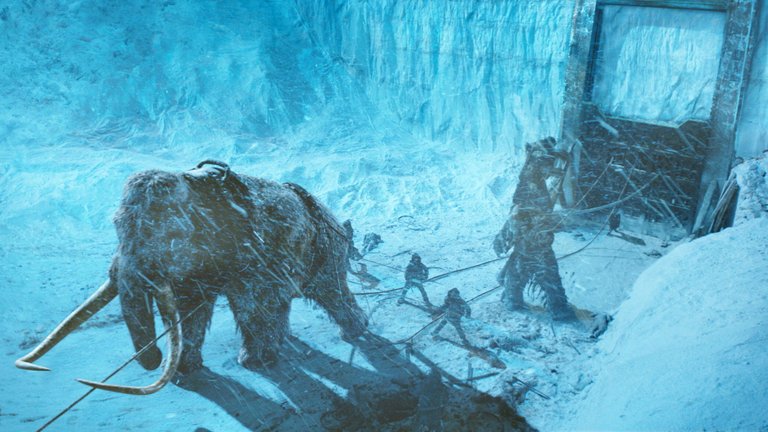
As the close-quarters combat rages below, Mance’s main force launches its assault on the Wall itself. The sequence is awe-inspiring, designed to elicit the same disbelief in the audience as it does in the watching Night’s Watchmen. Two giants and a mammoth, creatures of legend, emerge from the tree line to assault the gate with terrifying, primal strength. The defenders, though terrified, are not unprepared. They unleash prepared defences: cascading barrels of burning oil that create rivers of fire down the ice, and a monstrous, scythe-like mechanism (a creative addition by Marshall not found in George R. R. Martin’s source material) that sweeps wildlings from the Wall’s face. The spectacle is staggering. A mammoth and a giant are felled, but the surviving giant manages to breach the outer gate. The defence of the inner gate falls to a small band of six brothers, led by the steadfast Grenn (Mark Stanley). In a moment of pure, unadulterated heroism—a rarity in the cynical world of Westeros—they face their colossal foe by reciting their Night’s Watch vows, standing together as brothers until the end.
Back in the castle, Jon duels and finally kills Styr. The emotional core of the battle, however, is the tragic reunion between Jon and Ygritte. She, having wreaked havoc with her bow, finally has him in her sights. The hesitation on her face—a turmoil of love, betrayal, and duty—is beautifully captured by Rose Leslie. That hesitation proves fatal. Before she can make her choice, she is shot through the heart by Olly (Brennock O’Connor), a young boy whose family she has slaughtered. She dies in Jon’s arms. The personal cost of the larger conflict is made devastatingly concrete. With Ygritte’s death and Tormund’s capture, the battle within the castle winds down.
The aftermath is a portrait of pyrrhic victory. Jon discovers Grenn and his brothers dead at the inner gate, their bodies surrounding the slain giant—a tableau of ultimate sacrifice. Atop the Wall, Eddison Tollett (Ben Crompton) watches as Mance’s army, bloodied but far from broken, retreats into the forest. Jon coldly assesses the situation: the wildlings can afford their losses; the Night’s Watch cannot. They have bought a day, perhaps two. In a moment of desperate, arguably foolhardy leadership, Jon decides his only option is to go beyond the Wall under a flag of parley and assassinate Mance Rayder, hoping the death of the unifying king will shatter the wildling alliance. The episode ends on this cliffhanger, with Jon walking north into the unknown, the temporary victory feeling hollow and fragile.
While Blackwater rightfully earned a Hugo Award, Neil Marshall was clearly not content to simply repeat himself. The Watchers on the Wall represents a clear technical evolution. Both episodes used night battles to manage CGI constraints and employed flaming projectiles for visual clarity, but Marshall’s work here is more ambitious and assured. The larger budget and extended pre-production time yielded significant creative innovations. The most notable is the breathtaking 360-degree continuous shot that sweeps through the chaos of Castle Black’s courtyard. This unbroken take immerses the viewer in the sheer bedlam of the fight, showcasing the choreography, stunt work, and scale with a virtuosity previously unseen on the show. Similarly, an awe-inspiring aerial shot establishes the geography of the battle, clearly illustrating the simultaneous attacks from north and south. Marshall only briefly indulges in convention, using a slow-motion shot to emphasise the emotional weight of Ygritte’s death—a moment that, while slightly manipulative, is earned by the narrative.
The showrunners, David Benioff and D. B. Weiss, took greater liberties with the source material here than George R. R. Martin did with his Blackwater script. They condensed two separate wildling attacks from the books into one sustained, cinematic event. Yet, this compression works brilliantly. While the battle involves hundreds rather than the thousands suggested at Blackwater, it feels grander and more visceral. The action choreography is sharper, the stunt work more impressive, and the special effects—particularly the giants and mammoths—are a generational leap forward from the wildfire of Season 2. The addition of the Wall-scythe delivers visual spectacle that enhances the setting’s unique defensive character.
The episode’s emotional power is not solely derived from spectacle. Alongside the tragedy of Jon and Ygritte, it offers one of the series’ most genuinely heroic moments: Grenn and his brothers reciting their oath in the face of certain death. In a narrative increasingly defined by betrayal, cynicism, and moral ambiguity, this act of pure, selfless sacrifice is profoundly affecting. It reaffirms the core ideal of the Night’s Watch, reminding us what these men are ultimately fighting for.
Critics were quick to recognise the episode’s achievement, with many praising it as the most realistic and comprehensive depiction of medieval combat on television since the legendary Battle of Helm’s Deep in The Lord of the Rings: The Two Towers. Its timing within Season 4 was also narratively impeccable. It followed immediately after the devastating, hope-crushing climax of The Mountain and the Viper. Where that episode ended in brutal injustice and death, The Watchers on the Wall provides a victory—however costly—for the “good guys.” Jon Snow proves his mettle as a commander, and Sam successfully protects Gilly. Yet, true to the show’s ruthless realism, it avoids facile triumphalism. The victory is temporary, the enemy remains vast, and the cost was a generation of Night’s Watch brothers. Just as Robb Stark’s victories in the field did not prevent the Red Wedding, Jon’s success at the Wall may prove fleeting, raising the stakes for the season finale and anchoring the series’ enduring theme: in the game of thrones, and in the war for the dawn, you win or you die, and sometimes even winning comes at a price that feels like a kind of death.
The Watchers on the Wall is a high-water mark for Game of Thrones and for television spectacle. It takes the template established by Blackwater and refines it with greater technical prowess, narrative focus, and emotional resonance. It is a relentless, brilliantly constructed piece of television that balances immense scale with intimate tragedy, proving that the series could deliver battles that were not only visually breathtaking but also deeply integral to the soul of its story.
RATING: 9/10 (++++)
==
Blog in Croatian https://draxblog.com
Blog in English https://draxreview.wordpress.com/
InLeo blog https://inleo.io/@drax.leo
LeoDex: https://leodex.io/?ref=drax
InLeo: https://inleo.io/signup?referral=drax.leo
Hiveonboard: https://hiveonboard.com?ref=drax
Rising Star game: https://www.risingstargame.com?referrer=drax
1Inch: https://1inch.exchange/#/r/0x83823d8CCB74F828148258BB4457642124b1328e
BTC donations: 1EWxiMiP6iiG9rger3NuUSd6HByaxQWafG
ETH donations: 0xB305F144323b99e6f8b1d66f5D7DE78B498C32A7
BCH donations: qpvxw0jax79lhmvlgcldkzpqanf03r9cjv8y6gtmk9