Television Review: The Wolf and the Lion (Lost, S1X05, 2011)

The Wolf and the Lion (S01E05)
Airdate: 15 May 2011
Written by: David Benioff & D. B. Weiss
Directed by: Brian Kirk
Running Time: 55 minutes
At the very midpoint of its inaugural season, Game of Thrones decisively shifts from intricate table-setting to bloody, kinetic conflict. The Wolf and the Lion, the fifth episode, serves as the series’ first true catalyst for open war, its title leaving little doubt as to the opposing factions: the direwolf of House Stark and the lion of House Lannister, the two great powers whose simmering rivalry now erupts into violence. This episode is rightly remembered as the moment the plot’s engine roars to life, but it is equally notable for a stark escalation in both the graphic depiction of bloodshed and the actual body count. Writers and showrunners David Benioff and D. B. Weiss use this instalment to tear away the veneer of courtly politics and reveal the brutal, visceral reality of power in Westeros.
For the first time, the entire narrative remains confined to Westeros. The exiled Targaryens across the Narrow Sea are reduced to a subject of fraught discussion, yet they become the ironic catalyst for the central rupture in King’s Landing. This geographical focus intensifies the episode’s claustrophobic tension, as every scene feeds directly into the burgeoning Stark-Lannister feud.
The episode’s moral core remains Eddard Stark, a man profoundly unsuited to the viper’s nest of the capital. Bound by an unyielding Northern honour, he doggedly continues his investigation into the death of his predecessor, Jon Arryn. He receives seemingly helpful intelligence from the duplicitous Petyr Baelish, while the Master of Whisperers, Varys, attempts to win his favour with cryptic warnings about saving King Robert “from himself.” This political dance is masterfully tense, but it is Ned’s foundational friendship with Robert that provides the episode’s most significant fracture. Upon learning of Daenerys Targaryen’s pregnancy, Robert, in a blind panic at the prospect of a Dothraki invasion, orders her assassination. In a chilling Small Council scene, every member—including Varys, who we know is secretly treating with the Targaryens via their Braavosi sponsor Illyrio Mopatis (Roger Allam, introduced in first episode)—acquiesces. Only Ned stands against it, branding the murder of a pregnant woman as dishonourable. His refusal of the king’s command and subsequent resignation is a seismic act of principle that severs their bond and removes the last buffer between the Stark and Lannister factions. This decision is compounded when he learns his wife Catelyn has captured Tyrion Lannister, a move that makes the coming war inevitable.
Catelyn’s storyline is a thrilling, treacherous journey into the political hinterlands. Her ruse to take Tyrion to the Vale, rather than Winterfell, is a smart tactical play, but the journey itself descends into savage chaos. The attack by the hill tribes is a brutally effective set-piece, showcasing the random, unforgiving violence of the world beyond the castles. It also forces a fascinating character moment from Tyrion, who, despite being a prisoner, fights to save Catelyn’s life, notching his first kill in the process. This complexity is immediately contrasted by the gothic horror of the Eyrie. The introduction of unhinghed Lysa Arryn (Kate Dickie), and her disturbingly infantile son Robin (Lino Faccioli), completes the episode’s theme of corrupted motherhood and political insanity. Tyrion’s condemnation to a sky-cell—a prison open to a sheer mountain abyss—is one of the series’ most iconic and terrifying images of psychological torture.
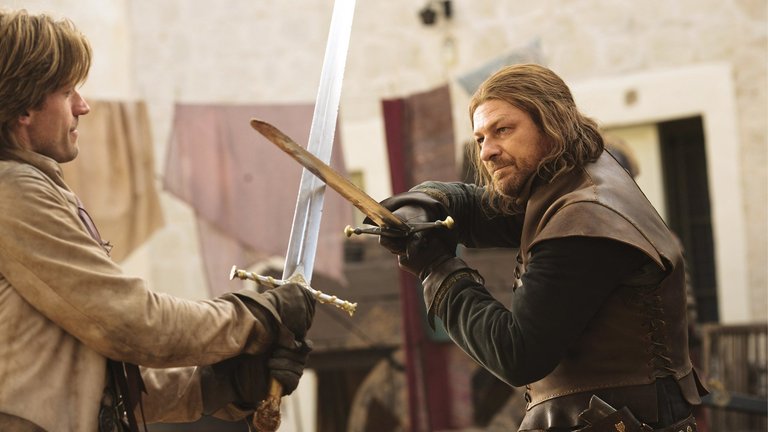
The episode’s climax returns to King’s Landing, where consequence meets violence head-on. As Ned prepares to depart, he is confronted by a vengeful Jaime Lannister. The ensuing street fight is short, brutal, and profoundly consequential. Jaime’s men slaughter Ned’s household guard, and Ned himself is left crippled by a spear thrust to the leg. This is a ruthless ambush, a statement that the rules of chivalry are dead. The choreography is efficient and messy, cementing the show’s commitment to realistic, impactful violence.
This visceral brutality is echoed in a seemingly peripheral tournament scene, which serves to introduce the charismatic Ser Loras Tyrell (Finn Jones). His joust against the monstrous Gregor Clegane is another expertly staged piece of action, but its aftermath is what resonates: Clegane’s petulant decapitation of his own horse is a moment of pure, shocking barbarism that tells us everything we need to know about the man called ‘The Mountain’. This violence is not merely spectacle; it is character definition.
The Wolf and the Lion also continues the series’ unabashed approach to sexual content, pushing boundaries in new directions. The depiction of a homosexual relationship between Loras and Renly Baratheon is groundbreaking for mainstream fantasy television. The scene is explicit, far more so than the subtle hints and innuendos of George R. R. Martin’s source material. While some criticised it as gratuitous, it serves a clear political purpose, establishing the Tyrells’ manoeuvring and Renly’s unsated ambition. In contrast, the heterosexual ‘sexposition’ falls flatter. Theon Greyjoy’s tryst with the prostitute Ros (Esme Bianco), while intended to explore his conflicted Ironborn identity, feels like a box-ticking exercise in nudity, a less inspired repeat of earlier techniques. The nudity within Baelish’s brothels is pervasive, but it is Lysa Arryn’s public breastfeeding of her nine-year-old son that delivers the episode’s most genuinely unsettling and thematically rich image of aberrant sexuality and maternal obsession.
Technically, the episode is a triumph of location and effect. The Eyrie and its mountainous surrounds are rendered with imposing grandeur, a seamless blend of Maltese locations, detailed matte paintings, and CGI that successfully sells this iconic, improbable fortress. Even amidst the action, the series finds time for vital exposition. Maester Luwin’s lesson to Bran about the great houses is direct but necessary world-building. More elegant is Arya’s discovery of giant dragon skulls deep beneath the Red Keep—a moment of awe and implicit exposition that whispers of a more magical, dangerous history lurking beneath the present political strife.
The Wolf and the Lion is the episode where Game of Thrones truly found its confident, ruthless voice. It masterfully accelerates the plot into open conflict, grounds its fantasy in brutally realistic violence, and is unafraid to use sex and shock for both character development and visceral impact. If the first four episodes were a careful orchestration of pieces, this is the moment the board is violently upended. The war has begun, and the episode leaves no doubt that it will be fought without mercy or honour.
RATING: 7/10 (+++)
Blog in Croatian https://draxblog.com
Blog in English https://draxreview.wordpress.com/
InLeo blog https://inleo.io/@drax.leo
LeoDex: https://leodex.io/?ref=drax
InLeo: https://inleo.io/signup?referral=drax.leo
Hiveonboard: https://hiveonboard.com?ref=drax
Rising Star game: https://www.risingstargame.com?referrer=drax
1Inch: https://1inch.exchange/#/r/0x83823d8CCB74F828148258BB4457642124b1328e
BTC donations: 1EWxiMiP6iiG9rger3NuUSd6HByaxQWafG
ETH donations: 0xB305F144323b99e6f8b1d66f5D7DE78B498C32A7
BCH donations: qpvxw0jax79lhmvlgcldkzpqanf03r9cjv8y6gtmk9