Television Review: Time's Arrow, Part II (Star Trek: The Next Generation, S6X01, 1992)

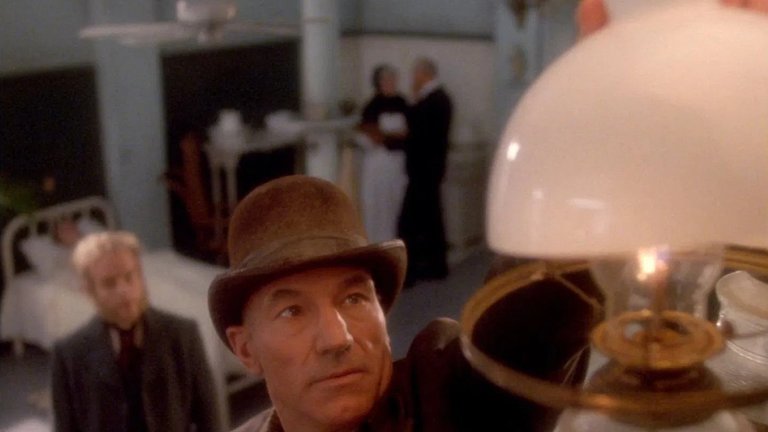
Time’s Arrow, Part II (S06E01)
Airdate: 21 September 1992
Written by: Jeri Taylor
Directed by: Les Landau
Running Time: 46 minutes
The premiere of Star Trek: The Next Generation’s sixth season arrived with considerable weight upon its shoulders. Following the creative resurgence of Season Five and amidst persistent, low-level rumours about the franchise’s longevity, Time’s Arrow, Part II had a dual mission: to deliver a satisfying resolution to its predecessor’s audacious cliffhanger and to reassure viewers that the flagship series remained in robust health. On both counts, it succeeded admirably, if not transcendently. This concluding chapter is a definitively stronger piece of television than the somewhat meandering first instalment, efficiently untangling its temporal knots with a pleasing, predestined logic. While it fails to scale the philosophical or dramatic heights typically associated with the show’s golden age, it nonetheless stands as a confident, professionally executed hour that effectively quashed any lingering fears of creative exhaustion or imminent cancellation. The series, it proclaimed, still had plenty of time on its side.
The episode picks up precisely where Part I concluded, stranding Captain Picard, Commander Riker, Counsellor Troi, Dr. Crusher, and Geordi La Forge in 1893 San Francisco. Disguised as contemporaries, their mission is twofold: locate the missing Lieutenant Commander Data and thwart the sinister, non-corporeal Devidians, who are harvesting human neural energy at the moment of death. The plot mechanics are set in motion with functional efficiency. Dr. Crusher’s medical expertise quickly identifies an unusual cholera outbreak as the Devidians’ gruesome method of masking their harvest within a natural epidemic. The subsequent chase from the hospital to the caverns beneath the city is briskly handled, culminating in a confrontation that has lasting consequences: a mortally wounded Devidian, an unstable temporal portal, and—in the episode’s most striking visual—the severing of Data’s head from his body. As the away team pursues the remaining alien through the portal, the irrepressible Samuel Clemens (Mark Twain), caught up in the adventure, impulsively follows, leaving Picard behind with a wounded, 19th-century version of Guinan.
The narrative then bifurcates. The away team, plus Twain, materialise back on the Devidian homeworld and are promptly beamed to the USS Enterprise. Twain’s wide-eyed tour of the 24th century provides the episode’s primary source of levity, though it arguably underutilises the profound culture shock such an experience would entail. Concurrently, in the past, Picard learns from a dying Devidian that destroying the time portal could unravel the universe itself. His solution is a masterstroke of elegant, circular writing: he places a warning etched on a piece of iron inside Data’s detached head, knowing it will be discovered centuries later by his own crew. This act perfectly closes the causal loop. Back in the 24th century, La Forge performs a technological miracle, reattaching Data’s recovered head and effectively resurrecting him. The android, with La Forge’s assistance, then devises a plan to use modified photon torpedoes to destroy Devidians without catastrophic paradoxes. The portal is reopened, allowing Twain to return to 1893 to aid the injured Guinan, while Picard rejoins his own time.
The resolution is notably satisfying, largely because Part I’s cliffhanger—the entire command crew seemingly stranded in the past—was a gamble that many fans and critics found frustratingly abrupt. Scriptwriter Jeri Taylor later revealed the considerable difficulty in engineering a payoff, noting that the writing team “threw all kinds of ideas” around during the production hiatus before landing on this solution. The final product justifies the struggle, presenting a plot that feels meticulously planned rather than conveniently contrived. Director Les Landau maintains a steady hand throughout, though the most impressive directorial and design work arguably belongs to Part I, with its charming sequences of the crew ingeniously blending into Victorian society by posing as a travelling theatre troupe. This commitment to period detail was rightly recognised with two Emmy Awards, for Outstanding Costume Design and Hairstyling.
The episode’s humour, often stemming from the crew’s anachronistic predicament, is generally well-judged. A highlight is Picard’s improvisation of a theatrical performance to placate their persistent landlady, Mrs. Carmichael (Pamela Kosh). Patrick Stewart seizes this moment, deploying his formidable Shakespearean prowess in a mock play that is both a delightful character beat and a clever plot device to avoid paying rent. However, the episode’s characterisation is not without flaw. The portrayal of Mark Twain, while energetically performed by Jerry Hardin, is criticised by some as overly broad and theatrical. His arrival on the Enterprise feels somewhat cursory; the profound implications of a 19th-century literary giant confronting the reality of interstellar travel are glossed over in favour of fish-out-of-water gags and technobabble. Consequently, Twain occasionally threatens to overwhelm the narrative, while the Devidians themselves remain poorly defined, almost ghostly afterthoughts serving more as a plot mechanism than compelling antagonists.
A more trivial, yet often noted, production footnote concerns Counsellor Troi. Perceptive viewers observed that Marina Sirtis sports a notably deep tan, conspicuously out of place for a Victorian lady. This was an unavoidable consequence of the actress returning from her honeymoon shortly before filming, a rare instance where off-screen life visibly intrudes upon the on-screen fiction.
Nevertheless, Time’s Arrow, Part II triumphs over its limitations. It is a great display of the show’s matured production machine and the strength of its ensemble. By providing a clever, coherent conclusion to a risky storyline, it demonstrated that The Next Generation could still handle complex, franchise-spanning narratives with aplomb. It may not be the most intellectually challenging or emotionally resonant episode of the season, but as a solid, entertaining piece of television craftsmanship, it successfully steadied the ship and pointed it confidently toward the future.
RATING: 6/10 (++)
Blog in Croatian https://draxblog.com
Blog in English https://draxreview.wordpress.com/
InLeo blog https://inleo.io/@drax.leo
LeoDex: https://leodex.io/?ref=drax
InLeo: https://inleo.io/signup?referral=drax.leo
Hiveonboard: https://hiveonboard.com?ref=drax
Rising Star game: https://www.risingstargame.com?referrer=drax
1Inch: https://1inch.exchange/#/r/0x83823d8CCB74F828148258BB4457642124b1328e
BTC donations: 1EWxiMiP6iiG9rger3NuUSd6HByaxQWafG
ETH donations: 0xB305F144323b99e6f8b1d66f5D7DE78B498C32A7
BCH donations: qpvxw0jax79lhmvlgcldkzpqanf03r9cjv8y6gtmk9