Television Review: Two for the Road (Lost, S2X20, 2006)

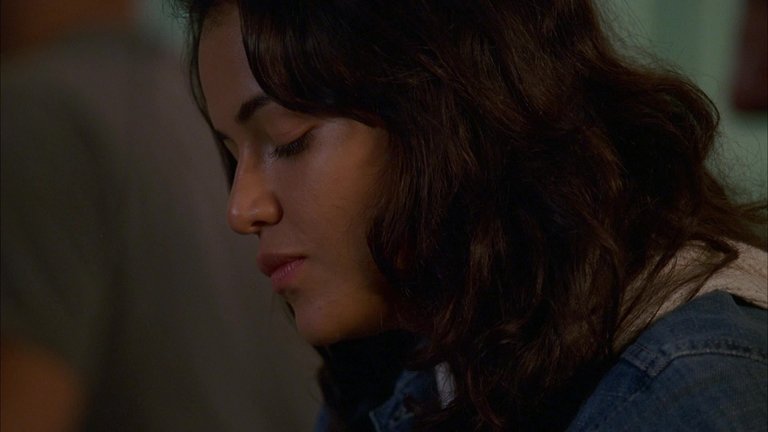
Two for the Road (S02E20)
Airdate: 3 May 2006
Written by: Elizabeth Sarnoff & Christina M. Kim
Directed by: Paul Edwards
Running Time: 43 minutes
By the latter half of its second season, Lost appeared to be settling into a troublingly conventional rhythm. The initial, potent mystique of the Others was being systematically demystified through glimpses of their mundane domesticity. More consequentially, the survivors’ immediate existential struggle—the primal hunt for food, water, and shelter—had been largely solved by the discovery of the well-stocked Swan Station. This sudden shift from stark survival drama to a relative comfort zone risked diluting the series’ essential tension, leading to a string of episodes that could feel, at times, curiously ‘soapish’ and inconsequential. The narrative required a corrective jolt, a reminder of the island’s inherent peril. An earlier attempt, Dave, deployed a controversial and largely unsuccessful red herring involving Hurley’s sanity. A far more effective, indeed devastating, alternative was provided by Two for the Road’. This episode engineered a shocking, visceral event that abruptly raised the stakes for every character, reasserted the ever-present danger, and delivered a ‘wham’ moment of such brutal finality that other shows would typically reserve it for a season finale.
As is often the case in Lost’s weaker instalments, the flashback narrative forms the episode’s most languid and superfluous segment. Continuing the saga of Ana Lucia Cortez, it details the events that led her onto Oceanic Flight 815. We open in an LAPD parking lot where Ana is confronted by her mother, Captain Cortez, regarding the killing of Jason McCormack, the man responsible for the death of her unborn child. The Captain knows her daughter ensured no evidence remained, but her scolding—a mix of professional disappointment and maternal fear—prompts Ana Lucia to quit the force in a fit of prideful defiance. Adrift, she subsequently works in airport security, where she is spotted and hired by Christian Shephard as a bodyguard for his trip to Australia. This thread is tantalisingly underdeveloped; Ana Lucia witnesses Christian’s mysterious meeting with a woman (presumably Claire’s mother), but spends most of her time futilely trying to prevent him from drinking himself to death. Frustrated, she quits, calls her mother in a moment of apparent reconciliation, and boards the fateful flight. While it reinforces Ana Lucia’s combustible combination of trauma, guilt, and impulsive agency, the flashback ultimately feels like a box-ticking exercise, adding little new dimension to a character whose defining island actions already painted a clear picture.
Back in the present day, the ongoing imprisonment of the man calling himself ‘Henry Gale’ in the Swan Station’s armoury is evolving from a logistical burden into a palpable danger. The tension crescendos during a feeding attempt, where ‘Henry’ launches a sudden, violent attack on Ana Lucia. He is subdued only by the timely intervention of John Locke. In the aftermath, ‘Henry’ cryptically explains to Locke that he refrained from harming him because Locke, unlike Ana Lucia, is “one of the good ones.” This remark sows a seed of doubt and special connection that Locke will fatally nurture. Ana Lucia, however, operates on a more pragmatic and vengeful frequency. Convinced that ‘Henry’ is an existential threat, she resolves to acquire a gun to deal with him permanently. She accomplishes this by seducing Sawyer, using the opportunity of their liaison to locate and steal a firearm. This scene is a stark, cynical transaction, juxtaposing intimacy with instrumental betrayal, and it perfectly encapsulates Ana Lucia’s damaged, utilitarian worldview.
Meanwhile, Michael, having recovered from his ordeal, delivers a game-changing report. He claims to have travelled through the jungle, located the Others’ camp, and discreetly observed it. His description is deliberately reassuring: the camp is organised around another hatch, contains only twenty-two individuals—mostly “weak” old men and women—and boasts only two firearms. His argument is compelling in its simplicity: the survivors, with their superior numbers and physical strength, could easily overwhelm them. This intelligence provides the combustible fuel for Jack Shepherd’s latent desire for offensive action. It convinces Jack to organise a war party, but to do so, he must first secure the arsenal—a task that requires him to confront and negotiate with Sawyer, the camp’s de facto arms dealer. Michael’s tale, delivered with a convincing mixture of exhaustion and zeal, is a masterful piece of misdirection, playing perfectly into the survivors’ desire for agency and retribution.
In a much-needed subplot providing tonal contrast, Hurley attempts to romance Libby. He plans an elaborate picnic, intending to take her to the same scenic beach Sayid used with Shannon. In a quintessentially Hurley mishap, his poor sense of direction leads them in circles, and they end up back on the main survivors’ beach. To compound the comedy, he has forgotten both blankets and wine. Undeterred by the farcical turn of events, they resolve to enjoy themselves regardless, with Hurley rushing off to fetch the wine and Libby heading to the Swan Station to fetch blankets. This gentle, achingly human storyline serves as the calm before the storm, its innocence and humour making the subsequent violence all the more gut-wrenching. It is a final, poignant glimpse of two characters seeking a simple, happy connection—a desire the island is about to violently extinguish.
The episode’s final act is a masterpiece of brutal economy and shocking narrative rupture. Ana Lucia enters the armoury, gun in hand, ostensibly to execute ‘Henry’. In a moment of profound character clarity, she hesitates, realising she cannot kill again. At that precise moment, Michael arrives. Seizing on her hesitation, he volunteers to perform the deed she cannot. A relieved and trusting Ana Lucia hands him the weapon. In a horrifying reversal, Michael immediately turns the gun on her and shoots her dead. The act is cold, calculated, and devastating. Before the audience can process this betrayal, Libby enters, cheerfully carrying blankets. Michael, now in a frenzy of tragic necessity, shoots her too. The episode then delivers its final, chilling beat: Michael opens the armoury door, points the gun at his own shoulder, and fires. The screen cuts to black. This sequence is executed with ruthless efficiency, leaving no room for sentiment or rescue. Two major characters are obliterated in moments, their storylines abruptly terminated.
Lost had, by this point, established a precedent for killing major characters with startling abruptness—Boone’s death in Season One being a prime example. However, the bloody finale of ‘Two for the Road’ represented a seismic escalation. To dispatch not one, but two series regulars in such a swift, clinical fashion was a profound shock to the audience, all the more heightened by the macabre irony of the episode’s title. The promise of a journey for two becomes a death sentence for two.
Yet, despite the visceral shock, the twist makes impeccable narrative sense upon reflection. Michael’s return was always shrouded in unease; his singular, obsessive quest to recover Walt at any cost had clearly crossed a moral event horizon. His claims about the Others’ vulnerability now appear as a brilliantly concocted ruse, a means to lure the survivors into a overconfident and likely catastrophic military engagement. Furthermore, the episode subtly hints at further layers of deception. ‘Henry’s’ whispered distinction between Locke and Ana Lucia suggests he, too, might be a renegade or an agent with divided loyalties, playing a deeper game. Michael’s betrayal is thus not a mere plot contrivance but the grim, logical culmination of his character’s desperate arc.
The killings themselves are differentiated in their tragedy. Ana Lucia’s death is a direct, almost predictable consequence of her own violent path; she is eliminated by the very weapon she sought, a victim of her own mission. Libby’s death, however, is an exercise in cruel, random futility. She is quite literally in the wrong place at the wrong time, an innocent bystander annihilated by a narrative grenade. This senselessness led many observers to draw parallels with the fate of Lizaveta (Elizabeth) in Dostoevsky’s Crime and Punishment—another innocent figure brutally cut down as collateral damage in a larger, morally compromised scheme. The script by Elizabeth Sarnoff and Christina M. Kim further layers this violence with a stark thematic juxtaposition: sex and violent death. Ana Lucia is killed shortly after her transactional encounter with Sawyer, while Libby is murdered while pursuing romantic happiness with Hurley. This echo is reinforced by the location itself—the same beach where Shannon enjoyed a moment of happiness with Sayid before she, too, was abruptly killed.
The episode also generated significant off-screen publicity and speculation. A vocal segment of the fanbase had grown intensely hostile towards Ana Lucia following her killing of Shannon, with calls for the character to be written out. Her death therefore appeared to some as a capitulation to fan demand. A more credible explanation, however, lies in the real-life circumstances of actresses Michelle Rodriguez and Cynthia Watros. Both were arrested for DUI during the production period, with Rodriguez even serving a brief jail sentence. Killing off their characters was a convenient, if drastic, solution to a burgeoning public relations and disciplinary problem for the producers. This decision, however, created narrative ripples, most notably leaving Libby’s intriguing backstory—her presence in the Santa Rosa mental institution alongside Hurley—permanently and frustratingly unresolved. Producers would later claim the decision to kill both characters had been planned a year in advance, a statement viewed with scepticism by many, given the fortuitous timing.
In any case, Two for the Road is one of Season Two’s most memorable and impactful episodes. It successfully arrested the season’s drift towards convention by delivering a narrative shockwave that irrevocably altered the character dynamics and raised the stakes to a fever pitch. It demonstrated Lost’s willingness to burn its own narrative furniture for the sake of dramatic intensity, reasserting the island’s capricious and deadly nature.
RATING: 7/10 (+++)
==
Blog in Croatian https://draxblog.com
Blog in English https://draxreview.wordpress.com/
InLeo blog https://inleo.io/@drax.leo
LeoDex: https://leodex.io/?ref=drax
InLeo: https://inleo.io/signup?referral=drax.leo
Hiveonboard: https://hiveonboard.com?ref=drax
Rising Star game: https://www.risingstargame.com?referrer=drax
1Inch: https://1inch.exchange/#/r/0x83823d8CCB74F828148258BB4457642124b1328e
BTC donations: 1EWxiMiP6iiG9rger3NuUSd6HByaxQWafG
ETH donations: 0xB305F144323b99e6f8b1d66f5D7DE78B498C32A7
BCH donations: qpvxw0jax79lhmvlgcldkzpqanf03r9cjv8y6gtmk9