Television Review: Unification I (Star Trek: The Next Generation, S5X07, 1991)

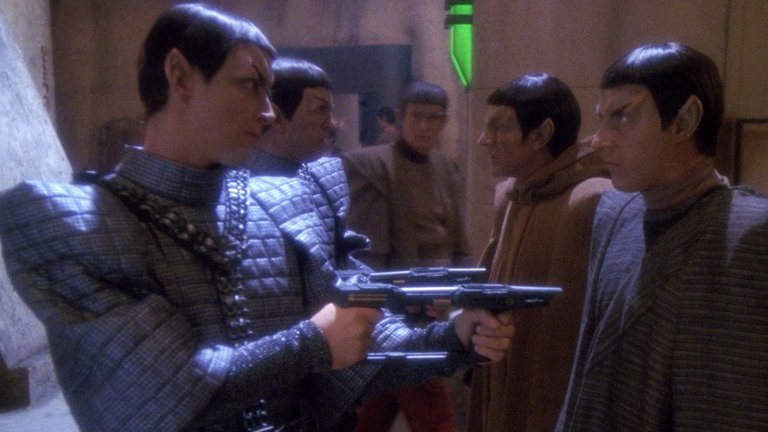
Unification I (S05E07)
Airdate: 4 November 1991
Written by: Jeri Taylor
Directed by: Les Landau
Running Time: 46 minutes
The conclusion of 1991 signified much more than the turning of a calendar page; for the devoted adherents of science fiction television, it marked the definitive end of an era within the Star Trek universe. This period was defined by two significant losses: the unexpected passing of the franchise’s visionary creator, Gene Roddenberry, and the cinematic farewell of Star Trek VI: The Undiscovered Country. That feature film was explicitly crafted to celebrate the twenty-fifth anniversary of The Original Series, with a narrative arc intended to symbolically conclude the journeys of its iconic protagonists as they rode off into the sunset. However, before Paramount executives could fully embrace this nostalgic conclusion, they had already conceived strategies to bolster the film’s promotion by leveraging the then-immensely popular and critically acclaimed Star Trek: The Next Generation (TNG). The resulting synergy produced the two-part episode Unification, which, at that point in the franchise’s timeline, represented the most substantial and tangible link between the original series canon and the new iteration.
The first part of this narrative, titled simply Unification I, premiered on 4 November 1991. Notably, this broadcast occurred just weeks after Roddenberry’s death, imbuing the episode with a sombre tone as it opened with a formal dedication to the late creator. The plot itself commences with Captain Jean-Luc Picard being summoned by Admiral Brackett (Karen Hensel). She informs him of an event that could potentially have devastating consequences for the Federation: Ambassador Spock (Leonard Nimoy), one of the most respected and experienced diplomats in Starfleet history, has effectively disappeared, only to be photographed on Romulus, a planet in the heart of Romulan space. This sighting raises the alarming possibility that he has defected to the Romulans. Picard proceeds to investigate, identifying a potential link through Spock’s father, Sarek (Mark Lenard). Picard had previously established a unique connection with Sarek via a mind meld, lending emotional weight to this investigation.
The Enterprise arrives on Vulcan, where Picard discovers Sarek is now a frail and demented man at the very end of his life. Despite his mental decline, Sarek proves surprisingly useful by recounting his public disagreement with his son regarding policies related to the Federation-Cardassian War. More crucially, he points to Pardek (Malachi Throne), an influential Romulan senator and Spock’s longtime associate, as the individual spotted on the photograph with the missing ambassador. To resolve the situation, Picard and Data decide to investigate personally by travelling to Romulus. They must pose as Romulans, a feat accomplished with assistance from Dr Crusher’s makeup and prosthetics. To cross the border and approach the planet undetected, they require a Klingon vessel with a cloaking device. They obtain this asset only after considerable difficulties from Gowron, the Klingon chancellor, who is keen on ensuring no one is aware that the Federation provided assistance in his coming to power during a recent civil war.
Simultaneously, the Enterprise, now under the command of Commander Riker, continues to investigate the disappearance of the Vulcan ship T’Pau, which might have clandestinely carried Spock to Romulus. Their trail leads to Surplus Depot 715, a salvage yard operated by a Zakdorn named Klim Dokachin (Graham Jarvis). His bureaucratic pedantry significantly hampers the investigation, although not as much as the sudden attack by a mysterious alien ship which ultimately gets destroyed in the chaos. After arriving on Romulus, Picard and Data successfully make contact with Pardek and are, in a moment of high anticipation, ultimately greeted by Spock.
Critically, Unification I stands as, thanks to the script by Jeri Taylor and competent direction by series veteran Les Landau, a solid transitional episode typical of two-parters, though it is hardly a great piece of television when viewed as a standalone narrative. Its main quality lies in the successful bridging of the two Star Trek eras through the character of Spock, but this is achieved indirectly. The episode leverages the character of Spock’s father, Sarek, who had already appeared in his own episode and arguably delivered one of the most emotional moments in TNG history. Here, the series remains consistent, allowing a character whose decline was merely hinted at in his final prior outing to perish as a pathetic, confused man unable even to make the famous Vulcan salute or offer a proper goodbye to Picard in their last encounter. This encounter is arguably the most memorable moment of the episode. His death, occurring off-screen, is nevertheless a tragic moment, compounded significantly by the context of Roddenberry’s death.
The actual appearance of Spock, arguably the most hyped-up guest appearance in Star Trek history and the primary driver for the episode achieving the best original viewing ratings of Season 5, is reserved for a brief cliffhanger-like glimpse at the episode’s end. Consequently, this structure makes the episode look somewhat formulaic and like a piece of broadcast television rather than an organic story of its own. Yet, even within the constraints of this formula, there are some genuinely good moments. The script continues to build the Klingon arc with Gowron’s complicated relationship with the Federation, adding political nuance. Furthermore, there are slightly humorous scenes featuring Picard and Data navigating their mission on the Klingon ship. Riker and the Enterprise crew being frustrated by the lonely bureaucrat provide another piece of humour, which is heightened even further by Troi unashamedly using her feminine charms to smooth things over during their interactions with Dokachin. These elements ensure that despite its structural limitations as a bridge between eras, the episode retains enough narrative texture to satisfy long-time fans.
While Unification I does not stand as one of the highest peaks of the Next Generation canon, it serves a vital historical function. It acts as a poignant funeral for the old guard of Star Trek while simultaneously integrating its most iconic figure into the narrative framework of the future. The episode’s reliance on nostalgia over narrative freshness is a necessary compromise given the context of its production, yet the emotional core provided by Sarek’s decline elevates it above a standard filler piece. It remains a testament to the enduring appeal of the franchise’s universe, proving that even in times of transition, the connection between the different eras of Star Trek can be forged through character drama rather than simple plot mechanics.
RATING: 6/10 (+++)
Blog in Croatian https://draxblog.com
Blog in English https://draxreview.wordpress.com/
InLeo blog https://inleo.io/@drax.leo
LeoDex: https://leodex.io/?ref=drax
InLeo: https://inleo.io/signup?referral=drax.leo
Hiveonboard: https://hiveonboard.com?ref=drax
Rising Star game: https://www.risingstargame.com?referrer=drax
1Inch: https://1inch.exchange/#/r/0x83823d8CCB74F828148258BB4457642124b1328e
BTC donations: 1EWxiMiP6iiG9rger3NuUSd6HByaxQWafG
ETH donations: 0xB305F144323b99e6f8b1d66f5D7DE78B498C32A7
BCH donations: qpvxw0jax79lhmvlgcldkzpqanf03r9cjv8y6gtmk9