Television Review: Wars to Come (Game of Thrones, S5X01, 2015)

Wars to Come (S5x01)
Airdate: 12 April 2015
Written by: David Benioff & D.B. Weiss
Directed by: Michael Slovis
Running Time: 52 minutes
Season 5 of Game of Thrones arrived with considerable expectation, yet its inaugural episode, Wars to Come, offered a curiously subdued and uneventful commencement. Functioning primarily as a narrative mop-up operation, the episode diligently tidied the sprawling aftermath of Season 4’s explosive finale—the death of Tywin Lannister, Tyrion’s flight, Jon Snow’s ascendance—but showed little urgency in propelling new stories forward. It was a table-setting hour, methodical to a fault, which prioritised repositioning pieces over generating palpable momentum. This slow burn, while arguably necessary, rendered the episode a somewhat languid re-entry into the world of Westeros and beyond.
Nevertheless, Wars to Come opens with a genuine novelty: a prologue. Departing from the series’ established format, the cold start depicts two young girls venturing into a wood to visit the hut of a witch named Maggy (Jodhi May). The blonde, imperious child (Nell Williams) declares her father owns all the land and demands her fortune. Maggy’s blood magic yields a chilling prophecy: the girl will marry a king, not a prince; be replaced by a younger, more beautiful queen; and witness all her children die before her. The revelation that this is a young Cersei Lannister retrospectively casts a long, ominous shadow over the entire series. This flashback technique, previously avoided by showrunners David Benioff and D. B. Weiss for fear of overcomplicating an already dense plot, proves a compelling addition. It provides crucial psychological underpinning for Cersei’s paranoia and ruthlessness, and Nell Williams adeptly mimics the signature hauteur and coiled menace of Lena Headey’s performance.
Back in the present, the episode’s central event is Tywin Lannister’s funeral at the Great Sept of Baelor. Here, the consequences of his death begin to crystallise. Cersei and Jaime, united in grief yet fundamentally adrift, are confronted by their cousin Lancel (Eugene Simon), now a gaunt, sober acolyte of the Sparrows. This fundamentalist movement, based on the Faith of the Seven, had been barred from King’s Landing by Tywin. His removal creates a power vacuum the Sparrows eagerly fill, their rise signalling a significant new threat to the decadent Lannister regime. The episode, however, stumbles in its handling of this faction. While George R. R. Martin’s novels root the Sparrows’ popularity in widespread popular disgust with the nobility’s war-driven famine and violence, the show offers little exposition. Their sudden prominence and ability to convert even Lannister kin like Lancel feels unearned, an abrupt narrative insertion rather than an organic societal shift. Cersei’s dismissive reaction to Lancel’s calls for repentance perfectly captures her arrogance, but it also highlights the show’s tendency to tell, not show, this new dynamic.
The episode’s most promising thread lies in Essos. Tyrion Lannister, vomit-stained and despondent, is unveiled in Pentos at the manse of Illyrio Mopatis. In a grand display of quiet intrigue from Conleth Hill, Varys outlines his grand design: the Seven Kingdoms need a new ruler. Tommen is weak, Stannis too rigid, leaving Daenerys Targaryen as the optimal candidate. Peter Dinklage portrays Tyrion’s profound nihilism with weary brilliance, his desire to “drink myself to death” a logical endpoint for the character. His eventual, reluctant agreement to travel east with Varys promises a fascinating intellectual pairing, though this segment feels like pure set-up, a promise of adventures to come rather than an adventure itself.
In Meereen, Daenerys’s rule faces its first serious internal threat. Her removal of the ancient Harpy statues has inflamed traditionalist sentiment, spawning the Sons of the Harpy, a secret society of masked assassins targeting isolated Unsullied. This plot effectively establishes the insoluble dilemma of the conqueror attempting to reform a foreign culture. Meanwhile, Hizdahr zo Loraq and Daario Naharis return from Yunkai. Hizdahr’s plea to reopen the fighting pits—albeit with free men volunteering—is a pragmatic suggestion to win hearts and minds, but Daenerys’s instinctive revulsion is palpable. Daario, revealing his own past as a slave pit-fighter, offers a more nuanced perspective, creating a nascent policy rift. Emilia Clarke conveys Daenerys’s growing isolation and anxiety well, particularly in a potent scene where she visits her chained dragons, Viserion and Rhaegal. Her loss of control over them in the catacombs is a terrifying metaphor for her slipping grip on the city itself.
Elsewhere, the narrative is thinner. Lord Baelish smuggles Sansa Stark out of the Vale, misleading Lord Royce about their destination. This mysterious westward journey feels like a placeholder, a transition between safe houses. Concurrently, Brienne and Podrick have a petty squabble about his suitability as a squire, a scene whose sole dramatic function seems to be placing them on the same road as Sansa’s carriage—a contrivance that highlights the season’s sometimes clumsy plotting.
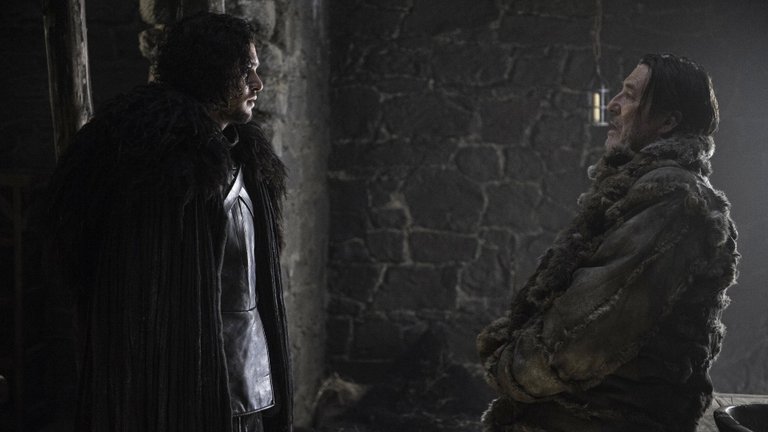
The episode’s most powerful sequence unfolds at the Wall. Stannis Baratheon, encamped at Castle Black, reveals his intent to reclaim the North from Roose Bolton. He needs the wildlings as recruits, but their allegiance hinges on their King-Beyond-the-Wall, Mance Rayder. Ciaran Hinds and Stephen Dillane excel in a tense standoff: Stannis, egged on by the fervent Melisandre, offers Mance a final chance to bend the knee. Mance’s refusal is steadfast, his dignity intact. His ironic blessing to Stannis for the “wars to come” provides the episode its title and a moment of profound tragic resonance. The subsequent burning is harrowing, a spectacle of zealous cruelty that discomforts all onlookers save the fanatical Queen Selyse. Jon Snow’s merciful arrow, defying Stannis’s authority, is a defining act of compassion and rebellion, perfectly setting the stage for his own fraught leadership challenges. This storyline alone delivers the moral complexity and emotional weight the episode elsewhere sometimes lacks.
Ironically, Wars to Come achieved the series’ highest viewing figures at that time, a record later broken in the same season. This popularity underscores a paradox: while it delivered the expected ingredients—political manoeuvring, moral dilemmas, spectacle—it remained a relatively uneventful instalment. Its pacing was deliberate, often slow, and much of its runtime was devoted to exposition and character repositioning.
The episode also continued HBO’s trademark “sexposition,” signalling that despite its mainstream ascent, Game of Thrones would not abandon its spicy content. Two scenes are notable. The first, an initially perplexing visit by an Unsullied officer to a brothel, is clarified when the prostitute Vala (Meera Rayan) provides a non-sexual service of cuddling and comfort—a poignant detail lifted directly from Martin’s texts that humanises the famously disciplined warriors. The second, depicting Loras Tyrell frolicking with the male prostitute Olyvar, serves a less noble purpose. Devoid of significant narrative function, it feels like gratuitous fan service, reducing a principal character to a simplistic stereotype for titillation.
Wars to Come is a competent but unspectacular season opener. Its strengths lie in its potent prologue, the compelling Wall storyline, and the promising alliance of Varys and Tyrion. Its weaknesses are equally apparent: the undercooked introduction of the Sparrows, some contrived plotting, and a general lack of forward thrust. It performed the essential groundwork, clearing the debris of the past so that the wars to come—both literal and political—could commence. Yet, one cannot shake the feeling that for an episode bearing such a portentous title, it spent rather too much time looking backward and not enough charging ahead.
RATING: 6/10 (++)
==
Blog in Croatian https://draxblog.com
Blog in English https://draxreview.wordpress.com/
InLeo blog https://inleo.io/@drax.leo
LeoDex: https://leodex.io/?ref=drax
InLeo: https://inleo.io/signup?referral=drax.leo
Hiveonboard: https://hiveonboard.com?ref=drax
Rising Star game: https://www.risingstargame.com?referrer=drax
1Inch: https://1inch.exchange/#/r/0x83823d8CCB74F828148258BB4457642124b1328e
BTC donations: 1EWxiMiP6iiG9rger3NuUSd6HByaxQWafG
ETH donations: 0xB305F144323b99e6f8b1d66f5D7DE78B498C32A7
BCH donations: qpvxw0jax79lhmvlgcldkzpqanf03r9cjv8y6gtmk9
Congratulations @drax! You have completed the following achievement on the Hive blockchain And have been rewarded with New badge(s)
You can view your badges on your board and compare yourself to others in the Ranking
If you no longer want to receive notifications, reply to this comment with the word
STOP