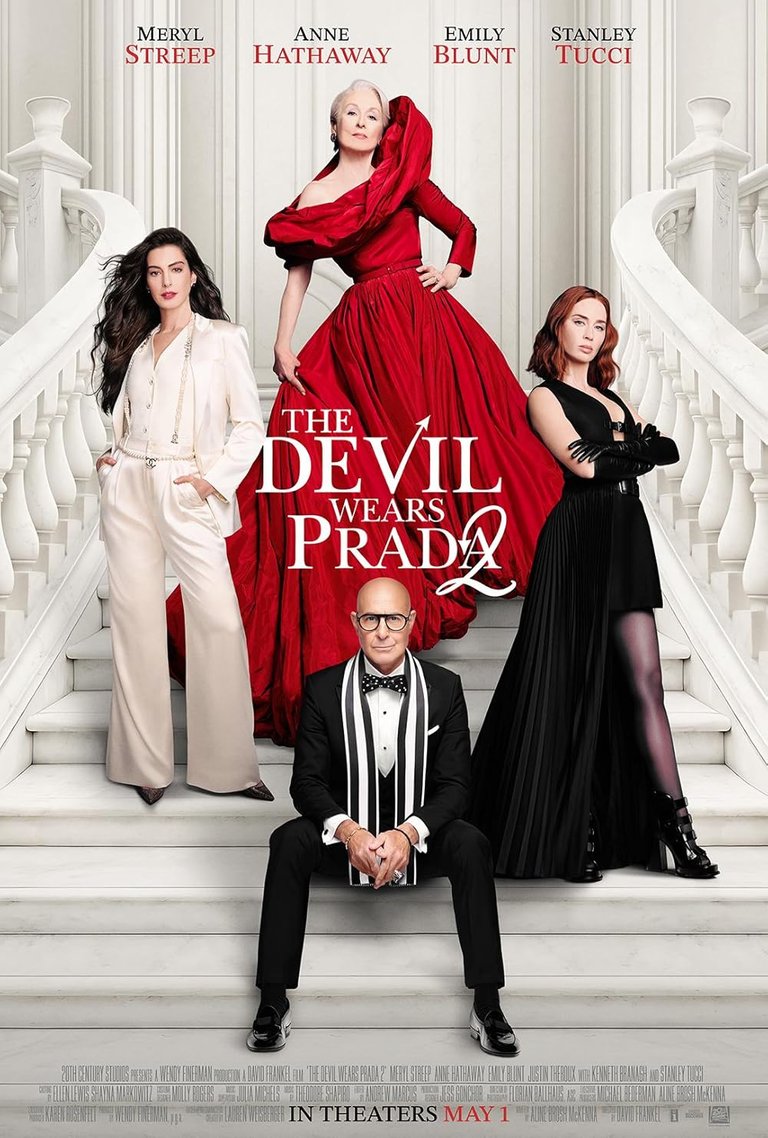
“The Devil Wears Prada 2” – a new reality for the world of fashion and journalism

USA, 2026, drama, director: David Frankel, starring: Meryl Streep,
Anne Hathaway, Emily Blunt.
The world of journalism has undergone a significant transformation. It started with the decline of print magazines and newspapers, which were gradually replaced by their digital counterparts. I've had a firsthand experience of this shift, having worked for a Ukrainian newspaper that pioneered the electronic format in the country. I witnessed the transition unfold before my eyes. Now, it seems that the owners of these publications are looking for ways to cut costs, and one of the measures they're taking is replacing human journalists with artificial intelligence. AI is being used to generate articles, which is a far cry from the kind of in-depth, investigative reporting that real journalists provide. The death of traditional journalism is a worrying trend, and it's hard to see how the quality of reporting can be maintained when machines are doing the writing. The personal touch, the nuance, and the critical thinking that a human journalist brings to a story are all lost when AI takes over. It's a sad state of affairs, and one that doesn't bode well for the future of journalism.
The fashion world may also be affected by changes: for example, fashion catwalks with real models will disappear, and videos of artificially generated models will appear in their place. This no longer looks like fiction.
The movie "The Devil Wears Prada 2" tackles these very issues. As the saying goes, everything that's old must eventually make way for something new - that's the mantra of those who champion innovation. But what happens when you have characters like Miranda, the powerful editor-in-chief of a high-end fashion magazine, and her employee Ann, who are determined to put the brakes on this process? Can they really succeed in slowing down the inevitable, or will they get swept away by the tide of change? The battle between tradition and innovation is about to get a whole lot more interesting.
I think the movie was too positive about the issues it brought up, because it's clear that AI is going to replace humans in every field, and if it hasn't happened in fashion yet, it's already happening in real journalism. Some of my colleagues are hopeful, saying that AI can't create anything original, it can only generate what's already out there, but I think the problem lies with the consumers themselves. They don't need real facts anymore, they're happy with a world where politicians create their own realities and try to figure out which one works best for their voters. Most people can't even tell the difference between real news and news generated by AI, which is often made-up and has no connection to reality. This is a big issue, because if people are satisfied with fake news, then what's the point of having real journalists? The line between what's real and what's not is getting blurrier, and it's hard to know what to believe anymore. I think this is a major problem, not just for journalism, but for society as a whole. We need to be able to trust the information we're getting, and right now, that's just not possible.
definitivamente hay que ver esta segunda parte, muy buen post
You definitely have to see this second part, very good post
Congratulations @nikaradeva! You have completed the following achievement on the Hive blockchain And have been rewarded with New badge(s)
Your next target is to reach 30 posts.
You can view your badges on your board and compare yourself to others in the Ranking
If you no longer want to receive notifications, reply to this comment with the word
STOPYour reflection on this film is very insightful; it confronts us with the current dilemma posed by the global impact of Artificial Intelligence (AI). Greetings, @nikaradeva.
Ooooh, yo vi la primera entrega, me gustó, no al punto de quedar fascinada o repetirlas varias veces, pero esta me resulta interesante, más por ese hecho del reemplazo de lo humano por la IA, me atrapastes, la veré. Por cierto, excelente reseña.
Ooooh, I saw the first one, I liked it, not to the point of being blown away or watching it multiple times, but this one seems interesting, especially because of the AI replacing humans. You've got me hooked, I'll watch it. By the way, excellent review.