Film Review: Chetniks! The Fighting Guerrillas (1943)

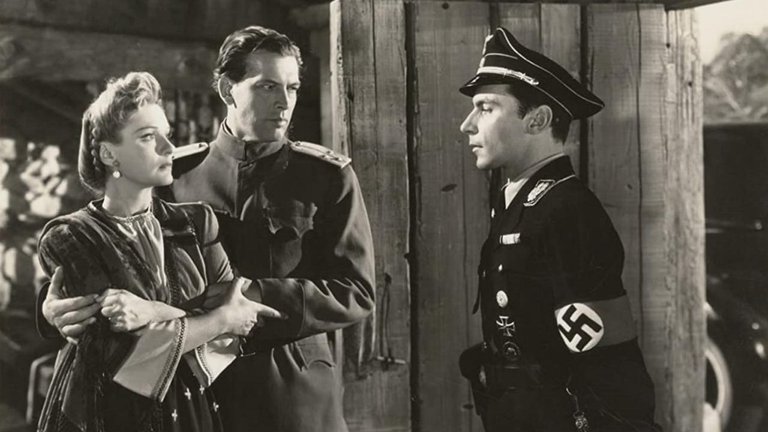
One of the most bizarre moments in the history of Yugoslav television occurred around 1983, during the airing of 3, 2, 1… kreni!, a popular film-related show produced by Radiotelevision Zagreb (today’s Croatian Television). The show, known for having famous guests and occasionally tackling controversial subjects, had shown the film which was at the time least likely to be allowed on the airwaves of Communist Yugoslavia. It mostly had to do with its content, which dealt with the Second World War in Yugoslavia in a manner that was contrary to the official (and until that time unquestionable) interpretation of that period.
The film in question was Chetniks! The Fighting Guerrillas!, a 1943 American war film directed by Louis King. The film was made during the war for the purposes of Allied propaganda, promoting and celebrating American allies or individuals and organisations that were engaged in resistance activities in territories under Axis rule. In the case of Chetniks!, that territory was the Kingdom of Yugoslavia, which had been invaded and occupied by Axis powers in April 1941, an event which led to the creation of resistance movements. During the actual production, the most celebrated of such organisations, officially endorsed by the Yugoslav government-in-exile, was the Yugoslav Army in the Fatherland (JVUO) led by Colonel Dragoljub “Draža” Mihailović. The film, made by 20th Century Fox, was explicitly dedicated to him.
The plot begins with Mihailović (played by Philip Dorn) leading his small, but well-trained and resourceful guerrilla force, known as “Chetniks”, in a series of ambushes and daring raids against German and Italian forces. These activities forced the Germans, commanded by General von Bauer (played by Felix Basch), to station seven divisions in order to guard their communications. Colonel von Brockner (played by Martin Kosleck), commander of the Gestapo, believes that he can force Mihailović to surrender if he captures his wife Ljubica (played by Anna Sten), who is, together with two children, hiding under an assumed name in the occupied city of Kotor. Brockner wants to starve and threaten citizens to give up Ljubica. Mihailović is aware of these plans thanks to Natalia (played by Virginia Gilmore), Brockner’s secretary who is a spy for the resistance. He devises his own plan to trick the Germans in a way that would allow him to free the hostages.
Like many Hollywood films before and afterwards, Chetniks! takes a cavalier approach to factual accuracy, and anyone familiar with the history and geography would notice many errors. The most obvious is Dutch actor Philip Dorn playing the protagonist as clean-shaven, making him clearly different from the iconic image of the bearded and bespectacled Mihailović. The plot is set in Kotor, a city on the Montenegrin coast, which was at the time of production occupied by Italians instead of Germans. There is even a character of Frau Spitz (played by Lisa Golm), a German schoolteacher who is trying to indoctrinate local children with National Socialism. Mihailović’s wife (played in the film by Russian actress Anna Sten) was in real life named Jelica instead of Ljubica, and they had three instead of two children (with Mihailović’s oldest son fighting with his father and being killed at the end of the war).
But those are minor complaints compared with the way Chetniks! oversimplifies the complex and messy reality of Yugoslavia during the Second World War. The country was ethnically and ideologically divided, and those divisions reflected not only on the population, but also on the resistance movements. The JVUO had a rival in the form of the Communist-dominated People’s Liberation Army of Yugoslavia (NOVJ) led by Josip Broz Tito. After tentative attempts to make a united front in 1941, both factions, due to differences in strategy and visions of the post-war future of the country, went into open conflict with each other, with the JVUO, on many occasions, finding all kinds of various arrangements with Axis occupiers. The JVUO had support almost exclusively limited to ethnic Serbs, and its main stronghold was Serbia proper, unlike the NOVJ which, since 1942, began to broaden support in Bosnia, Slovenia and Croatia. The capitulation of Italy in 1943 allowed the Partisans to gain large amounts of weapons that would allow them to get the upper hand over the Chetniks and, being more useful to Western Allies from a strictly military standpoint, they were recognised as a regular force and began to enjoy Allied political and logistical support.
Mihailović was increasingly marginalised and, following the end of the war, attempted to launch an anti-Communist insurgency. The attempt ended with his spectacular capture in 1946, followed by a public trial where he was found guilty of war crimes and treason. In the Serb anti-Communist diaspora, Mihailović was hailed as a martyr, and in the early 1980s, first attempts to revise or question official truths about WW2 were often seen as one of the first manifestations of Serb nationalism in Yugoslavia. It is easy to imagine that the unprecedented move of showing Chetniks! on national television, followed by show host Ivan Hetrich describing the film as an “ordinary lie”, had the purpose of nipping such trends in the bud. Whatever the intention was, Serb nationalism wasn’t suppressed; by the end of the decade it played a major part in the process that would result in the violent dissolution of Yugoslavia. Somewhat ironically, in many online debates about the 1990s wars and their roots in the Second World War, Serb nationalists were using Chetniks! as an argument for their cause.
Viewers unburdened with the complicated history of Yugoslavia, on the other hand, might find Chetniks! to be an unremarkable but solid piece of Classic Hollywood craftsmanship made within the limits of wartime propaganda. Louis King, a director specialised in westerns and adventure films, puts a relatively limited budget to good use, with locations and sets that could reasonably pass as Montenegro. The script by Jack Andrews and Edward E. Paramore Jr. makes an effective combination of action, pathos, a little romance and occasional comedy. Dorn and Sten are solid in their roles, and the same can be said for Basch and Kosleck who play the villains. Composer Hugo Friedhofer delivers solid music, with “Spremte se, spremte, četnici”, the unofficial Chetnik anthem, being used as its main motif.
The main asset of the film is its short running time. Although definitely not an accurate depiction of history, it is recommendable to cinephiles interested in curiosities from Hollywood’s past.
RATING: 5/10 (++)
Blog in Croatian https://draxblog.com
Blog in English https://draxreview.wordpress.com/
Leofinance blog https://leofinance.io/@drax.leo
Unstoppable Domains: https://unstoppabledomains.com/?ref=3fc23fc42c1b417
Hiveonboard: https://hiveonboard.com?ref=drax y
Bitcoin Lightning HIVE donations: https://v4v.app/v1/lnurlp/qrcode/drax
Rising Star game: https://www.risingstargame.com?referrer=drax
1Inch: https://1inch.exchange/#/r/0x83823d8CCB74F828148258BB4457642124b1328e
BTC donations: 1EWxiMiP6iiG9rger3NuUSd6HByaxQWafG
ETH donations: 0xB305F144323b99e6f8b1d66f5D7DE78B498C32A7

Posted using CineTV
Congratulations @drax! You have completed the following achievement on the Hive blockchain And have been rewarded with New badge(s)
You can view your badges on your board and compare yourself to others in the Ranking
If you no longer want to receive notifications, reply to this comment with the word
STOPCheck out our last posts: