Film Review: Germany, Year Zero (Germania anno zero, 1948)

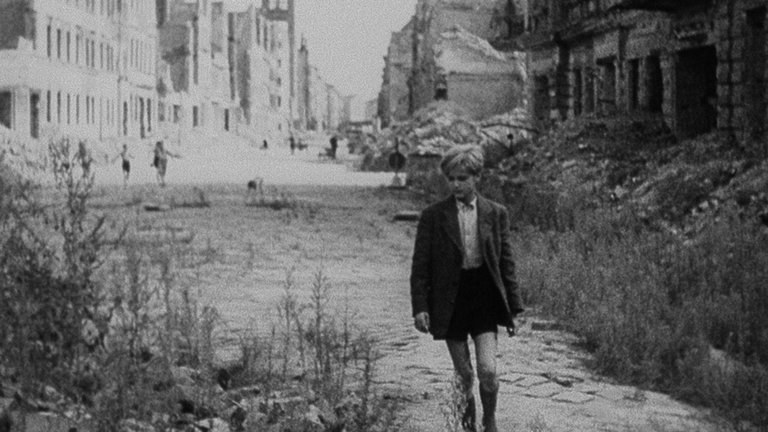
Many of the celebrated cinema classics aren’t the films the average audience would enjoy watching. This is especially the case with Italian neorealism, due to its unpleasant themes of poverty and moral devastation caused by the Second World War. One such example was provided by Roberto Rossellini, founding father of Italian neorealism, in his 1948 drama Germany, Year Zero, the final and darkest part of his “Neorealist trilogy”.
The phrase “year zero” in the title is inspired by “Zero hour” (or “Stunde null” in German), a concept which was becoming popular in Germany in the years following defeat in the Second World War. The phrase depicts 8 May 1945 – the date when the German capitulation to the Allies went into effect – as the point when Germans broke away from their totalitarian and militaristic past and began to build a new peaceful, humanistic and democratic country that would one day be allowed to rejoin the family of “normal” nations.
For many Germans, starting from scratch wasn’t a matter of choice – the country was not only occupied and divided by Allied powers, but also utterly devastated and its people deprived not only of traditions but of the bare necessities of life. That situation was most visible in the German capital of Berlin, where the plot of the film takes place. The once magnificent city was mostly reduced to rubble, with survivors, like 12-year-old protagonist Edmund Köller (played by Edmund Moeschke), forced to share a cramped apartment in a half-ruined building with an ailing, bed-ridden father (played by Ernst Pittschau) and two adult siblings – sister Eva (played by Ingetraud Inze) and brother Karl-Heinz (played by Karl Otto Krüger). While Eva goes out at night and entertains Allied servicemen for cigarettes and trinkets that could later be bartered for food on the black market, Karl-Heinz, a Wehrmacht veteran who fought to the bitter end, fears that he might end up in a POW camp, so he hides and doesn’t apply for food rations. This leaves Edmund, who has stopped going to school, as the main provider for the family, and he does so by engaging in petty crime and black-market schemes. Along the way he stumbles upon his former teacher Herr Henning (played by Erich Gühne), an unrepentant Nazi who involves Edmund in some of his schemes but also teaches him that “the weak should perish to make room for the strong”. This makes Edmund contemplate a monstrous deed that could solve some of his family’s problems.
For Roberto Rossellini, Germany, Year Zero was a more personal film than the first two parts of the trilogy - Rome, Open City and Paisan. This film was dedicated to his son Romano, who had died of appendicitis two years earlier, and Edmund Moeschke, a young circus acrobat without any acting experience, was cast in the main role largely because he physically resembled the director’s son. Rossellini, however, got the idea of making the film while visiting Berlin and noticing certain similarities and differences between Italy and Germany, concluding that the conditions of the latter would be best depicted on screen in the Neorealist style. While some of the techniques – like shooting on location and the use of non-professional actors – were maintained, some of the scenes were shot in Cinecittà studios. This included some of the German actors and crew having to travel to Italy, where they found the economic conditions and climate much preferable to their bleak and devastated homeland, so much so that some refused to leave. This just shows how devastated Germany was in the post-war years.
Rossellini captured this not only through panoramic shots of blocks of random buildings, but also through the script, co-written by Max Kolpe and Carlo Lizzani, which shows an even bigger devastation within people, whose entire lives were turned upside down, every tradition and certainty of the past was swept away, and whose morality was eroded by the endless need to procure small quantities of food every day. Rossellini doesn’t go all the way when showing the consequences of the collapse of very German concepts of law, order and discipline. While criminality is rampant, the crimes are still rather petty, and some of its darker aspects like prostitution and paedophilia are only implied. All that makes Edmund’s actions near the end more shocking and the film’s conclusion even bleaker. Rossellini’s pessimism is underlined by the almost complete lack of characters the audience could sympathise with. The closest among them is the father, played by veteran silent-era actor Ernst Pittschau, who expresses regret at the choices his country made during his life, resulting in losing world wars and rampant inflation.
Germany, Year Zero was hailed by critics, but with significantly less enthusiasm than his previous two films. This might be explained by anti-German sentiment, which was still strong in the world’s public in the first years after the war, and which made audiences reluctant to accept a film that would portray Germans, even innocent civilians, as victims. Some of the more snobbish critics complained about Rossellini abandoning his Neorealist principles by using studios and professional actors. Rossellini, however, did shoot on locations and the film contains some impressive shots that give insight into a Berlin that existed shortly before the Marshall Plan, Cold War agendas and the German economic miracle would transform it beyond recognition. But in order to see this document, the audience has to endure a less-than-interesting plot and a somewhat overlong, confusing and utterly disappointing ending, which is made worse by Renzo Rossellini’s melodramatic musical score.
Germany, Year Zero, however, still deserves a recommendation as a solid piece of cinema, an interesting historic document and a warning of what could happen to countries and civilisations that took their power, prosperity and enlightenment for granted.
RATING: 6/10 (++)
_
Blog in Croatian https://draxblog.com
Blog in English https://draxreview.wordpress.com/
InLeo blog https://inleo.io/@drax.leo
InLeo: https://inleo.io/signup?referral=drax.leo
Unstoppable Domains: https://unstoppabledomains.com/?ref=3fc23fc42c1b417
Hiveonboard: https://hiveonboard.com?ref=drax y
Bitcoin Lightning HIVE donations: https://v4v.app/v1/lnurlp/qrcode/drax
Rising Star game: https://www.risingstargame.com?referrer=drax
1Inch: https://1inch.exchange/#/r/0x83823d8CCB74F828148258BB4457642124b1328e
BTC donations: 1EWxiMiP6iiG9rger3NuUSd6HByaxQWafG
ETH donations: 0xB305F144323b99e6f8b1d66f5D7DE78B498C32A7
Posted using CineTV