Film Review: Helen of Troy (1956)

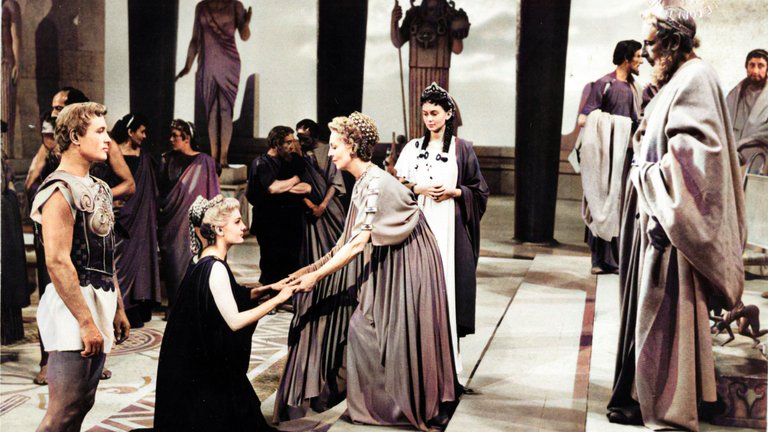
Certain films benefit a great deal from low expectations, especially when those low expectations coincide with relative obscurity, the passage of time, and inevitable comparisons with more recent productions. One such example can be found in Helen of Troy, a 1956 historical epic directed by Robert Wise.
Relatively loosely inspired by ancient Greek legends and Homer’s famous epic poem, the Iliad, the plot is set around 1100 BC. Troy, a rich city-state on the east coast of the Aegean Sea, has sent its Prince Paris (played by Jacques Sernas, credited as “Jack Sernas”) to Sparta in the hope of striking a trade deal with King Menelaus (played by Niall McGinnis) and avoiding a costly war. The mission fails because Paris meets Menelaus’s wife Helen (played by Rosanna Podesta), the most beautiful woman in the world. The two fall in love, and Paris escapes Sparta with Helen, which is well-received by Paris’s father, King Priam (played by Cedric Hardwicke). Her escape from Sparta, on the other hand, causes outrage among Greek kings, including Agamemnon (played by Robert Douglas), the Mycenaean king and king of Mycenae, who easily persuades other kings and warlords like Achilles (played by Stanley Baker) to launch a massive campaign of conquest under the excuse of avenging the wrong. The massive Greek army lands near Troy but appears unable to conquer the city, just as the Trojans, led by heroic prince Hector (played by Harry Andrews), are unable to throw the invaders back to the sea. After much bloodshed, the Greeks finally gain the upper hand when Ulysses (played by Torrin Thatcher), the crafty king of Ithaca, devises a clever ruse in the form of a wooden horse.
Despite being one of the more ambitious Hollywood productions of its time, Helen of Troy sank into relative obscurity, where it stayed for nearly half a century before interest in it was renewed with the release of Troy, a historical epic that could be seen as its remake. Both films have a lot in common – they were both produced by Warner Bros., they had enormous budgets for their time, and their scripts abandoned any supernatural elements from the literary source, interpreting events through the prism of Bronze Age geopolitics. Robert Wise, a very experienced director by that time, had top technical resources at his disposal, since Warner, like other studios, tried very hard to fight emerging competition from television by providing a visual spectacle that tiny boxes with black-and-white images could not match. Helen of Troy was one of many such projects made with the new technique of Cinemascope, which allowed impressive widescreen vistas, as well as Warnercolor, the studio’s own technique of colour cinematography, which represented a huge improvement over the increasingly impractical Technicolor. But the most important thing that made Helen of Troy “larger than life” was the use of thousands of extras and spectacular sets, the latter being provided by Cinecittà studios in Rome, which were becoming a powerhouse of world cinema at the time.
Despite many similarities, Helen of Troy is a very different film from Troy, but the inevitable comparisons give a slight edge to the earlier film. The main reason is that the script is tighter, more focused, and slightly more faithful to the traditional narrative, with the filmmakers’ sympathies clearly tilted towards the Trojans, who are portrayed as peaceful people who just want to preserve their freedom and way of life, unlike the aggressive, cynical, and tyrannical Greek invaders, who look very much like Soviets in Cold War propaganda. Helen of Troy is a good film, but in the end, it is nearly ruined by the terrible miscasting of Paris and Helen. While a case could be made that Italian actress Rosanna Podesta might be seen as “the face that launched a thousand ships” and Jacques Sernas has the proper looks for the role of a dashing prince, both of them did not speak English and had to have their voices replaced by poor dubbing. This, as well as the lack of chemistry between the actors, undermines the most important plot element of Helen of Troy. Wise’s film is nevertheless a solid piece of cinema that could be enjoyed by viewers who are not hardcore cinephiles. Those who are might be interested in the film which featured French superstar Brigitte Bardot making her first Hollywood appearance in the small role of Helen’s handmaiden Andraste, or the film in which future Italian filmmaking legend Sergio Leone gained valuable experience as assistant director.
RATING: 5/10 (++)
Blog in Croatian https://draxblog.com
Blog in English https://draxreview.wordpress.com/
InLeo blog https://inleo.io/@drax.leo
InLeo: https://inleo.io/signup?referral=drax.leo
Unstoppable Domains: https://unstoppabledomains.com/?ref=3fc23fRc42c1b417
Hiveonboard: https://hiveonboard.com?ref=drax y
Bitcoin Lightning HIVE donations: https://v4v.app/v1/lnurlp/qrcode/drax
Rising Star game: https://www.risingstargame.com?referrer=drax
1Inch: https://1inch.exchange/#/r/0x83823d8CCB74F828148258BB4457642124b1328e
BTC donations: 1EWxiMiP6iiG9rger3NuUSd6HByaxQWafG
ETH donations: 0xB305F144323b99e6f8b1d66f5D7DE78B498C32A7
Posted using CineTV
Congratulations @drax! You have completed the following achievement on the Hive blockchain And have been rewarded with New badge(s)
Your next target is to reach 165000 upvotes.
You can view your badges on your board and compare yourself to others in the Ranking
If you no longer want to receive notifications, reply to this comment with the word
STOPTo support your work, I also upvoted your post!
Check out our last posts: