Film Review: My Darling Clementine (1946)

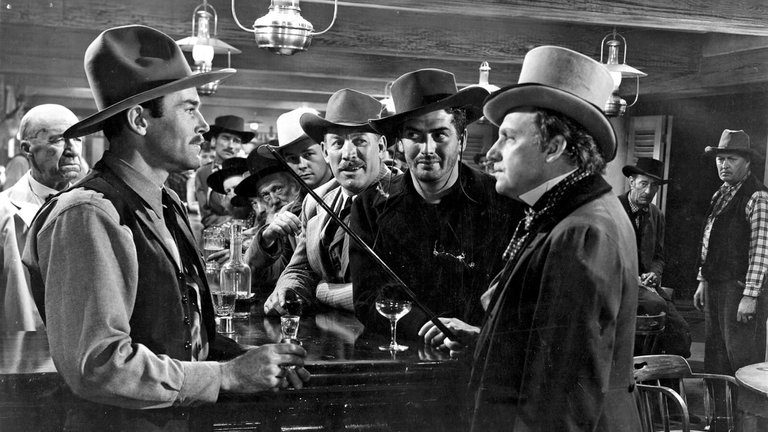
Few events have laid the foundation for the popular mythology of the Wild West as the 1881 incident in Tombstone, Arizona, later known as the Gunfight at the O.K. Corral. The largest contributor to the Wild West mythology was Hollywood and, rather unsurprisingly, one of the people who would take part in that process was John Ford, a top Western mythographer. In 1946 he covered the event with My Darling Clementine, a film that would later be hailed as one of the classics of the Western genre.
The film is based on Wyatt Earp: Frontier Marshal, a 1931 book by Stuart N. Lake dedicated to the Wild West’s most legendary lawman, which was previously adapted for the screen under the title Frontier Marshal in 1934 (starring George O’Brien) and 1939 (starring Randolph Scott).
The plot of My Darling Clementine begins in 1882 when Wyatt Earp (played by Henry Fonda) with his three brothers – Virgil (played by Tim Holt), Morgan (played by Ward Bond) and James (played by Don Garner) – are driving a cattle herd from the East to California. Along the way, the Earps decide to make a rest stop in the booming but violently lawless town of Tombstone. Wyatt there proves to be the only man capable of handling armed troublemakers. After returning to camp only to find the cattle stolen and James murdered, Wyatt decides to take the offer of becoming the town’s marshal in order to find the killers.
He meets and gradually befriends Dr. John “Doc” Holliday (played by Victor Mature), a former surgeon who turned into a professional gambler with a reputation as a notorious gunfighter. Chihuahua (played by Linda Darnell), a Mexican singer and Doc’s girlfriend, is rattled when Clementine Carter (played by Cathy Downs), Doc’s love interest, comes to Tombstone to look for him. She flirts with Billy Clanton (played by John Ireland), son of Old Man Clanton (played by Walter Brennan), leader of a family of notorious cattle thieves.
John Ford was more qualified to make this film than others due to personally knowing Wyatt Earp during his twilight years, when the famous lawman enjoyed the status of a minor celebrity during the birth of Hollywood. Yet, despite being familiar with Earp, his life and adventures, Ford all but completely abandoned any attempt to make My Darling Clementine historically accurate. Apart from the Earps and Doc Holliday fighting the Clantons at the O.K. Corral, the names of major characters and a few other minor details, almost everything in this film is pure fiction, including the fate of the protagonists.
Some of those script inventions that would make any serious Wild West historian apoplectic were partly the result of the tight censorship regime of the MPAA Production Code, which, for example, barred any mention of the profession practised by Wyatt Earp’s and Doc Holliday’s real-life romantic partners, which were respectively replaced by their fictional counterparts in the forms of a “regular” singer and an aspiring schoolteacher. Those viewers not interested in learning history from Hollywood films would, on the other hand, appreciate My Darling Clementine as a standard genre product made by one of the greatest talents of the Classic Hollywood era.
The film functions well and employs archetypal genre motifs of Good vs. Evil and civilisation vs. lawlessness. Ford directs the film very well, using his favourite locations of Monument Valley, with which he had fallen in love during the production of his masterpiece Stagecoach seven years earlier, as a background. An interesting variation of style is the almost complete absence of a conventional music soundtrack, which makes My Darling Clementine at times look and feel like an art film, especially when compared with the loud, action-packed version of the same story in Tombstone nearly half a century later.
My Darling Clementine is well-directed, but it suffers because of an unrefined script, which fails to properly establish reasons why such different personalities like Wyatt Earp and Doc Holliday would become friends. This wastes the great talents of Henry Fonda, whose portrayal of Earp as a mostly quiet, determined man of few words and plenty of action actually resembles testimonies of people who actually knew the historical personality. The same can be said of Victor Mature, one of the most underrated actors of his generation, who delivered arguably his greatest performance as a mortally ill gunslinger (although not as strong as Val Kilmer in Tombstone).
Things are much worse with Linda Darnell and Cathy Downs, whose bowdlerised romantic subplots look quite syrupy, at least in comparison with the much more colourful historic truth. The general impression is saved by the good work of character actors with whom John Ford traditionally had good rapport. Even Walter Brennan shines in a relatively small role as the main villain, despite having clashed with Ford on the set.
My Darling Clementine, despite its flaws, became a solid box office hit and later became enshrined as one of the great Western classics among Ford-worshipping film scholars. Although it doesn’t actually live up to its lofty reputation, today’s viewers, at least those that like the genre, might appreciate it as a good example of Ford’s talent.
RATING: 6/10 (++)
_
Blog in Croatian https://draxblog.com
Blog in English https://draxreview.wordpress.com/
InLeo blog https://inleo.io/@drax.leo
InLeo: https://inleo.io/signup?referral=drax.leo
Stars Arena: https://www.starsarena.com/?ref=draxblog
Unstoppable Domains: https://unstoppabledomains.com/?ref=3fc23fc42c1b417
Hiveonboard: https://hiveonboard.com?ref=drax y
Bitcoin Lightning HIVE donations: https://v4v.app/v1/lnurlp/qrcode/drax
Rising Star game: https://www.risingstargame.com?referrer=drax
1Inch: https://1inch.exchange/#/r/0x83823d8CCB74F828148258BB4457642124b1328e
BTC donations: 1EWxiMiP6iiG9rger3NuUSd6HByaxQWafG
ETH donations: 0xB305F144323b99e6f8b1d66f5D7DE78B498C32A7
Posted using CineTV