Film Review: Pinocchio (1940)

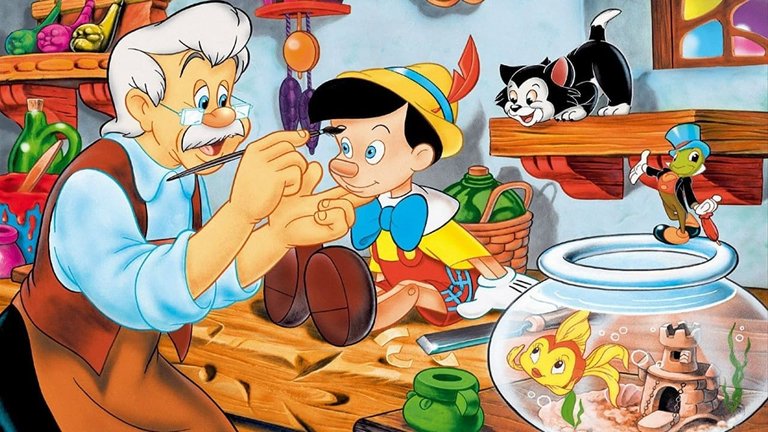
Film technology never made such spectacular advances as in the period between the two world wars. In 1919, all cinemagoers could watch were black-and-white silent films, while in 1939 all they watched were sound films, some of them even in colour. Some wonders of new technology were, however, more expensive, complicated and demanding than others. By the end of the 1930s, Hollywood had produced only two animated features. The first of those, Snow White and the Seven Dwarfs, was released by Walt Disney in 1937 after three years of gruelling work and immediately became not only a massive hit but one of the most celebrated films of all time. Not wanting to rest on his laurels, Disney began work on another animated feature, and in 1940 the result of his work was Pinocchio, another of his classics.
The film is based on The Adventures of Pinocchio, an 1883 book by Italian author Carlo Collodi, which is now considered to be one of the classics of children’s literature. The plot begins in a small Italian town in the 19th century when Jiminy Cricket (voiced by Cliff Edwards) comes to sleep in the house of Geppetto (voiced by Christian Rub), an old and kind-hearted wood-carver who lives with his cat Figaro and goldfish Cleo. Geppetto has just finished a marionette called Pinocchio, whom he wishes to become a real boy. After he goes to sleep, the Blue Fairy (voiced by Evelyn Venable) comes and, in order to reward Geppetto for making so many people happy with his puppets, decides to grant his wish and gives life to Pinocchio (voiced by Dickie Jones). He is, however, to become a real boy only if he deserves it, and Jiminy Cricket volunteers to be his conscience.
The next day, Geppetto sends Pinocchio to school, but on the way he is met by an anthropomorphic cat, “Honest” John Fortington Foulfellow (voiced by Walter Catlett), and his sidekick Gideon the Cat. They talk Pinocchio into skipping school and becoming an actor, but their real aim is to sell him to Stromboli (voiced by Charles Judels), a greedy and cruel puppeteer, who uses Pinocchio in his shows. Pinocchio is freed by the Blue Fairy, but, as he tries to return to Geppetto, he is again led astray, this time by the mysterious Barker (also voiced by Judels) who brings him and many other errant boys to Pleasure Island, where they enjoy smoking, drinking and vandalising, unaware that they are going to be turned into donkeys and later sold as slave labour. Pinocchio escapes with Jiminy’s help but later learns that Geppetto was swallowed by a giant whale, Monstro (voiced by Thurl Ravenscroft), while trying to find him.
For Disney and his studio, Pinocchio was a much more daunting task than Snow White. Unlike the simple and archetypal story from the Brothers Grimm books, Collodi’s book is episodic in nature and, at times, quite dark. The plot had to be simplified, and the main character made more likeable. The screenwriting was a very long and arduous process, which went hand in hand with changes in the look of Pinocchio, who gained more human and fewer puppet features as the production went on. Disney, while appreciating Collodi’s text and having the plot in its essence faithful to the source, also understood that adaptation must conform to the requirements of new media and that certain changes, sometimes even drastic, were necessary.
The result of his efforts is a film that is at the same time a Disney classic and a certain departure from the Disney formula. The most interesting thing about Pinocchio is the relatively large number of villains (Honest John, Barker, Monstro) who appear periodically and, unlike villains in other Disney films, don’t receive “proper” punishment for their misdeeds. This, on the other hand, allows the audience to focus their attention on the character of Pinocchio, who goes through a transformation from a lifeless puppet through a naive boy to a heroic character who ultimately saves the day.
The most brilliant decision Disney made with Pinocchio was to reboot the character of Jiminy Cricket, who doesn’t appear much in Collodi’s work, but who here becomes not only a narrator and comic relief, but almost the real protagonist, a character that would serve as Pinocchio’s conscience and helper in his critical moments. Jiminy Cricket, voiced by popular singer Cliff Edwards, despite not actually looking like a real cricket, became one of the most popular and the most iconic characters in the history of Disney productions. Even the supporting character of Figaro the Cat became popular enough to warrant an appearance in a number of Disney animated short films in the 1940s.
But in the end, the success of Pinocchio lies in its universal appeal to audiences. Older audiences are very likely to identify with the kind-hearted and likeable Geppetto. Younger audiences are not only going to identify with Pinocchio but also receive some important lessons about responsibility and doing what is right instead of what feels good. This message is conveyed through rather impressive feats of animation, with artists making sure to fill almost every corner of the picture with moving objects. But the final piece of the puzzle was music. This included a soundtrack by Leigh Harline and Paul J. Smith that would ultimately win an Oscar for Best Original Music. The title song “When You Wish Upon a Star” won an Oscar for Best Original Song, became a massive hit and remains one of the most recognisable pieces of music from the Classic Hollywood era. Many decades later, it also served as one of the inspirations for Spielberg’s Close Encounters of the Third Kind.
Pinocchio was one of the most expensive productions of its time, with a budget of US$2.46 million. As such, like so many ambitious projects of its time, it struggled to bring profit to its creators, mainly due to many foreign markets being closed to Hollywood studios due to the Second World War. Unsurprisingly, Pinocchio recouped its costs only after re-releases in 1945, which were followed at regular intervals until 1992, helping not only to bring this extraordinary story to newer generations but also to maintain this film’s reputation as one of the greatest works of Classic Hollywood, a reputation which is likely to endure and not be affected by usually inferior remakes like the 2022 live-action version directed by Robert Zemeckis.
RATING: 9/10 (++++)
Blog in Croatian https://draxblog.com
Blog in English https://draxreview.wordpress.com/
Leofinance blog https://leofinance.io/@drax.leo
Unstoppable Domains: https://unstoppabledomains.com/?ref=3fc23fc42c1b417
Hiveonboard: https://hiveonboard.com?ref=drax y
Bitcoin Lightning HIVE donations: https://v4v.app/v1/lnurlp/qrcode/drax
Rising Star game: https://www.risingstargame.com?referrer=drax
1Inch: https://1inch.exchange/#/r/0x83823d8CCB74F828148258BB4457642124b1328e
BTC donations: 1EWxiMiP6iiG9rger3NuUSd6HByaxQWafG
ETH donations: 0xB305F144323b99e6f8b1d66f5D7DE78B498C32A7
Posted using CineTV
Congratulations @drax! You have completed the following achievement on the Hive blockchain And have been rewarded with New badge(s)
Your next target is to reach 140000 upvotes.
You can view your badges on your board and compare yourself to others in the Ranking
If you no longer want to receive notifications, reply to this comment with the word
STOPTo support your work, I also upvoted your post!
Check out our last posts:
I love Disney animated films, classic animated films. however I don't like them now because their live action movies are destroying the original and everything
https://reddit.com/r/cine/comments/16e3ucz/film_review_pinocchio_1940/
The rewards earned on this comment will go directly to the people sharing the post on Reddit as long as they are registered with @poshtoken. Sign up at https://hiveposh.com.